
[ October 11, 2026 ]
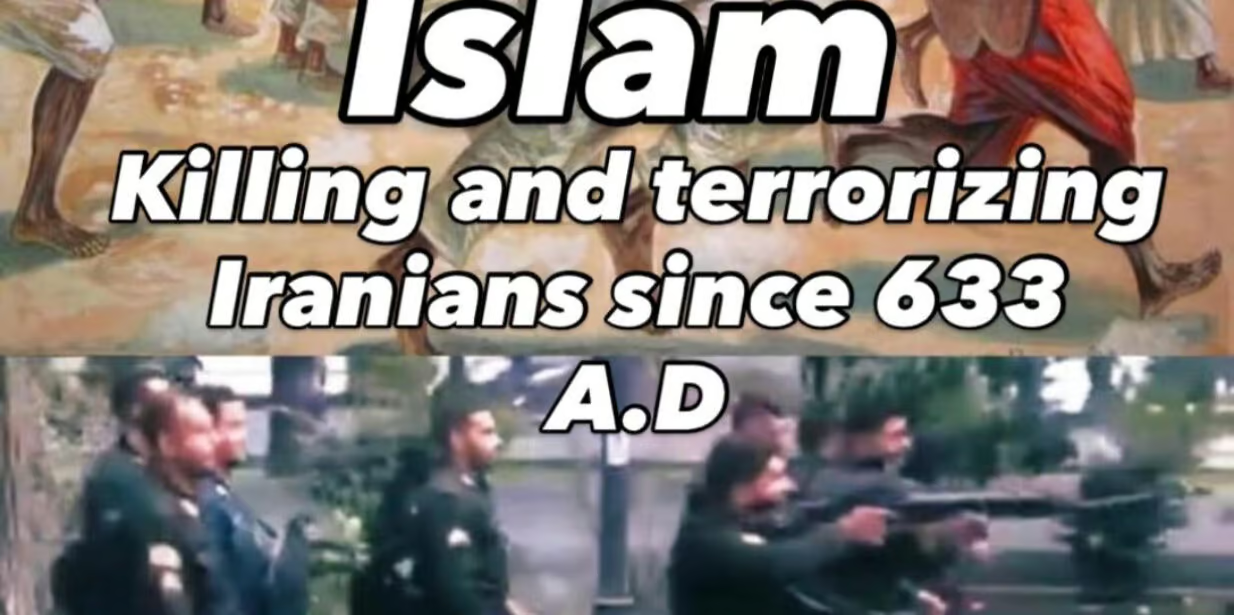
When an Iranian dissident proclaims that “the greatest killer of Iranians has been Islam,” the statement is less an exercise in academic historiography than a cry of immediate political exhaustion. Across the diaspora and within the quiet corners of Tehran, Isfahan, and Shiraz, a powerful counternarrative has taken hold. Confronted with the gallows, morality police, and institutional dogmatism of the Islamic Republic, many Iranians have turned history into a weapon of resistance. In this narrative, the seventh-century Arab conquest is not a distant chapter in antiquity, but the original sin of Persian history – an ongoing catastrophe linking the fall of the Sasanian capital of Ctesiphon in 637 A.D. directly to the prison yards of Evin today.
To understand contemporary Iran, one must grasp the potency of this neo-nationalist memory. Yet to understand Iran’s actual past, one must untangle this emotional countermyth from the messy realities of imperial violence, political pragmatism, and cultural assimilation.
The foundational pillar of the anti-clerical narrative is the catastrophic rupture of the Rashidun conquest. The popular memory laments a sophisticated, enlightened Zoroastrian civilization abruptly dismantled by religious fanaticism.
ADVERTISEMENT
The historical reality was far more mundane and agonizingly political. By 633 A.D., the Sasanian Empire was an exhausted shell. Decades of brutal, total war against the Byzantine Empire had depleted the treasury, shattered the peasant economy through punitive taxation, and broken the imperial army. Internal dynastic fratricide saw nearly a dozen claimants’ cycle through the throne in a span of four years.
When the Arab Muslim armies advanced across the Mesopotamian floodplains, they encountered an empire already unraveling from within. Many regional dehqans (landed nobility) and Nestorian Christian minorities negotiated surrenders and retained their administrative posts rather than sacrifice themselves for a fractured Sasanian court. The subsequent conversion of the Iranian plateau was not a sudden, sword-point event; it took over three centuries of fiscal pressures, social incentives, and localized assimilation before Muslims formed a demographic majority.
The dissident text draws a continuous line of religious terror through later conquerors such as Timur (Tamerlane) and Agha Mohammad Khan Qajar. Here, historiography diverges sharply from theological polemic.
Timur was a Turco-Mongol conqueror of terrifying efficiency who constructed minarets of human skulls across the Middle East. While he invoked Islamic rhetoric to legitimize his campaigns, he massacred Sunni and Shi’i populations with equal ferocity, from Baghdad to Damascus and Isfahan. His violence was the legacy of the Eurasian steppe empire – A.D. terror designed to force rapid capitulation – not a campaign to impose Quranic dogma on Persians.
Similarly, when Agha Mohammad Khan blinded thousands of men in Kerman in 1794, his fury had nothing to do with religious piety. He was a ruthless dynastic warlord extinguishing the rival Zand dynasty to consolidate the Qajar Empire. Folding these bloody campaigns into an unbroken “thread of Islamic terror” strips regional history of its political and dynastic context, reducing complex geopolitics into a single religious motive.
ADVERTISEMENT
The true paradox of Iranian history lies in what happened after the conquest: Persia did not merely survive; it thoroughly captured its conquerors.
While the languages and cultures of Roman Egypt, the Levant, and North Africa were largely Arabized, Iran retained its linguistic and cultural autonomy. Through the Shu’ubiyya literary movement of the ninth century, Persian scholars asserted their cultural superiority within the caliphate. Under the Abbasids, the machinery of imperial governance – from viziers and tax ledgers to court etiquette – was overwhelmingly staffed by Persians.
Ferdowsi’s Shahnameh revived the Persian language and pre-Islamic mythology, codifying a distinct Iranian civilizational identity. Thinkers like Ibn Sina (Avicenna), Al-Biruni, and Al-Razi operated within an Islamic framework while drawing extensively upon classical Persian, Indian, and Hellenistic traditions. Iranian culture was not an inert victim of a foreign creed; it fundamentally reshaped Islamic civilization into a Perso-Islamic ecumene.
Why, then, does the narrative of absolute religious rupture remain so compelling today?
Because inside the Islamic Republic, history is never academic; it is ideological warfare. For over four decades, the ruling theocracy has attempted to erase or diminish pre-Islamic heritage, framing everything prior to 622 A.D. as Jahiliyyah (an age of pagan ignorance). School curriculums were engineered to prioritize religious martyrdom over national antiquity.
In response, the Iranian public engineered a mirror image of the regime’s dogma. Where the state proclaims Islam brought total enlightenment, dissidents proclaim it brought total destruction. Pre-Islamic symbols – the tomb of Cyrus the Great at Pasargadae, the Faravahar, the fire temples of Yazd – have become subversive counter-symbols of freedom. When young women remove their headscarves to chants of “Zan, Zendegi, Azadi” (Woman, Life, Freedom), they are rejecting an ideology that has weaponized faith to control their bodies, lives, and modern aspirations.
The emotional cry that “Islam is the greatest killer of Iranians” is historically simplistic, but sociologically revelatory. It is the raw voice of a society that has endured decades of ideological enclosure and chosen to look back into the deepest wells of its memory to imagine a future free of clerics. Iran’s greatest triumph has never been ethnic purity or religious isolation, but its stubborn, millennia-old capacity to outlive every ideology that sought to erase it.
The Truth Must be Told
Your contribution supports independent journalism
Please take a moment to consider this. Now, more than ever, people are reading Geller Report for news they won't get anywhere else. But advertising revenues have all but disappeared. Google Adsense is the online advertising monopoly and they have banned us. Social media giants like Facebook and Twitter have blocked and shadow-banned our accounts. But we won't put up a paywall. Because never has the free world needed independent journalism more.
Everyone who reads our reporting knows the Geller Report covers the news the media won't. We cannot do our ground-breaking report without your support. We must continue to report on the global jihad and the left's war on freedom. Our readers’ contributions make that possible.
Geller Report's independent, investigative journalism takes a lot of time, money and hard work to produce. But we do it because we believe our work is critical in the fight for freedom and because it is your fight, too.
Please contribute here.

or
Make a monthly commitment to support The Geller Report – choose the option that suits you best.
ADVERTISEMENT
Quick note: We cannot do this without your support. Fact. Our work is made possible by you and only you. We receive no grants, government handouts, or major funding.Tech giants are shutting us down. You know this. Twitter, LinkedIn, Google Adsense, Pinterest permanently banned us. Facebook, Google search et al have shadow-banned, suspended and deleted us from your news feeds. They are disappearing us. But we are here.
Subscribe to Geller Report newsletter here— it’s free and it’s essential NOW when informed decision making and opinion is essential to America's survival. Share our posts on your social channels and with your email contacts. Fight the great fight.
Follow Pamela Geller on Gettr. I am there. click here.
Follow Pamela Geller on Trump's social media platform, Truth Social. It's open and free.
Remember, YOU make the work possible. If you can, please contribute to Geller Report.
Join The Conversation. Leave a Comment.
We have no tolerance for comments containing violence, racism, profanity, vulgarity, doxing, or discourteous behavior. If a comment is spammy or unhelpful, click the ... symbol to the right of the comment to let us know. Thank you for partnering with us to maintain fruitful conversation.




recent Comments