
[ October 10, 2026 ]
The Supremacy of Law: Why Constitutional Allegiance Demands More Than a Boilerplate Oath
By: Amil Imani
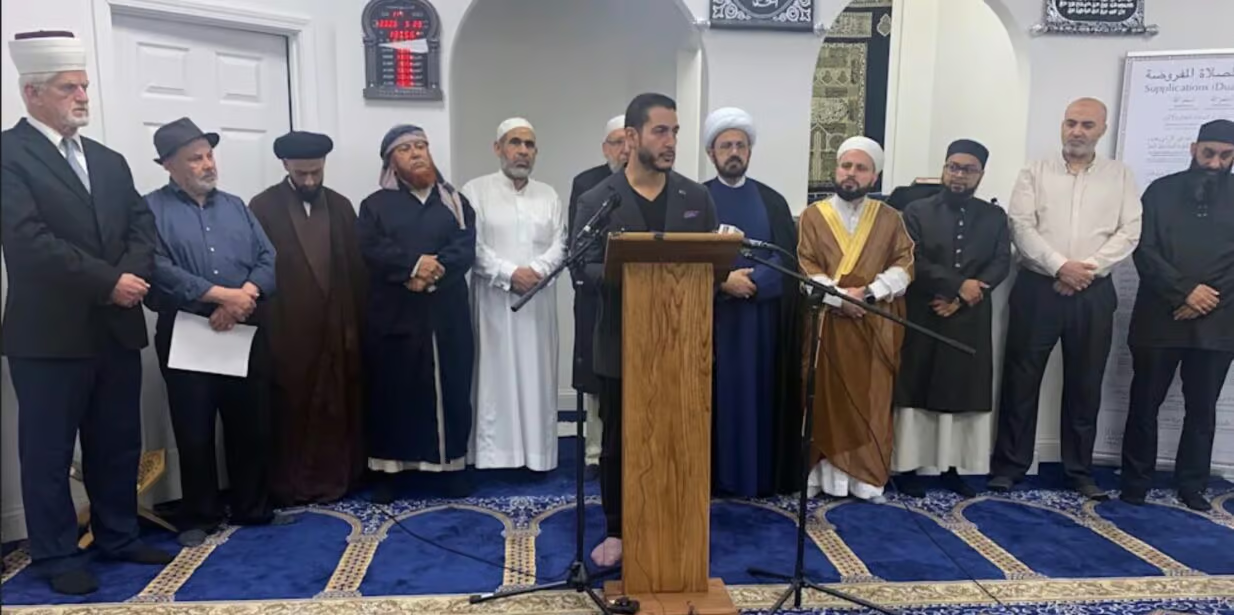
Western political commentary frequently treats religion as a purely private affair – a matter of personal devotion, moral reflection, and weekend rituals. From that vantage point, applying deep theological scrutiny to a political candidate like Abdul El-Sayed is dismissed as bigotry or a violation of democratic norms. But having grown up within orthodox Islam, studied its classical texts, and ultimately walked away from them, I know that this framing misunderstands the fundamental nature of the legal tradition at stake.
The central tension facing any observant candidate seeking legislative power is not racial, cultural, or superficial. It is fundamentally philosophical: Can an individual who claims fidelity to classical Islamic jurisprudence genuinely uphold the ultimate sovereignty of the United States Constitution?
ADVERTISEMENT
The core premise of American constitutionalism is popular sovereignty – the radical idea that human beings, through collective deliberation and representation, possess the authority to author, debate, alter, and repeal their own laws. The U.S. Constitution begins with the phrase, “We the People.”
In classical Islamic jurisprudence (fiqh), however, sovereignty (hakimiyya) belongs solely to God. Under this doctrine, human beings are not legislators in the true sense; they are executors and interpreters of a pre-existing divine law (Sharia). The moral and civil order is revealed, fixed, and immutable.
When a lawmaker sits in a secular legislature, their fundamental duty is to treat human-authored law as supreme. If a constitutional amendment or statutory provision contradicts traditional jurisprudence, where does an observant believer’s true allegiance lie? For those who believe divine edicts supersede human conventions, placing positive civil law above divine revelation is not merely a political compromise – it borders on theological apostasy. Underlying this legal reality is a simpler historical conclusion: Islam’s origins reflect the earthly ambitions of a single seventh-century tribal leader in the Arabian desert, rather than an unalterable divine decree.
So called scholars often attempt to sanitize Sharia by comparing it to Catholic canon law or Jewish Halakha, arguing it merely dictates prayer schedules, dietary laws, and charitable donations. Anyone who has studied the legal compendiums across the major schools of jurisprudence (madhahib) knows this is an evasion.
Classical Sharia is, by definition, a comprehensive legal and political system. It contains specific, binding rulings on:
ADVERTISEMENT
- Freedom of Conscience: Classical codes mandate severe criminal penalties for apostasy and blasphemy, directly conflicting with the First Amendment.
- Equality Under the Law: Traditional jurisprudence establishes clear civil and legal disparities based on gender and religious affiliation, particularly regarding inheritance, testimony, and family law.
- The Authority of the State: It envisions a civic order where civil authority is subordinate to religious jurisprudence.
To argue that these components do not exist – or that they are irrelevant to an individual’s worldview – ignores centuries of documented legal tradition. While the so-called modern, progressive Muslims may attempt to reinterpret or bypass these rulings, the underlying theological texts remain authoritative in orthodox institutions. Voters deserve to know whether a candidate treats those classical rulings as archaic historical relics or as binding moral ideals.
Defenders point to the official oath of office as a sufficient safeguard. But oaths are expressions of intent, and intent is shaped by underlying values. In mainstream political discourse, voters routinely scrutinize the foundational worldviews of socialist, libertarian, or conservative candidates to determine how they will exercise power in unforeseen crises. Why should a religious legal philosophy be exempt from the exact same standard?
An oath to the Constitution requires an uncompromising acknowledgment that the Constitution is the supreme law of the land, superior to any ancient text, theological pronouncement, or religious authority. It demands an explicit willingness to vote for, enforce, and protect laws that may fundamentally violate orthodox dogma – including full legal protections for ex-Muslims, religious dissidents, and social equality.
Without a transparent, unequivocal repudiation of classical legal supremacy, voters are asked to place blind faith in political packaging.
What makes this dynamic particularly potent is the strategic asymmetry at play: a democratic constitution is used as both an ideological shield and a vehicle for advancement. The First Amendment’s robust guarantees of religious liberty and free exercise provide an impenetrable defense against public inquiry, while the machinery of secular governance offers the platform to institutionalize influence.
In this view, a system fundamentally designed to prevent theological hegemony ends up being utilized to legitimize and advance a worldview whose ultimate jurisprudential premises reject secular supremacy. By operating entirely within the procedural rules of the host republic, an agenda rooted in classical religious law can progress under the guise of civic participation, leveraging the very constitutional safeguards that were intended to preserve a secular state.
Scrutinizing a candidate’s commitment to constitutional supremacy is not discrimination; it is the fundamental responsibility of an informed electorate.
ADVERTISEMENT
Until candidates with deep ties to orthodox communities openly and publicly affirm that human-made, secular constitutional law permanently supersedes divine jurisprudence on every civic and legal question, voters have every rational reason to withhold their support. The defense of a secular republic requires unflinching vigilance – and it begins by refusing to ignore what the texts actually say.
The Truth Must be Told
Your contribution supports independent journalism
Please take a moment to consider this. Now, more than ever, people are reading Geller Report for news they won't get anywhere else. But advertising revenues have all but disappeared. Google Adsense is the online advertising monopoly and they have banned us. Social media giants like Facebook and Twitter have blocked and shadow-banned our accounts. But we won't put up a paywall. Because never has the free world needed independent journalism more.
Everyone who reads our reporting knows the Geller Report covers the news the media won't. We cannot do our ground-breaking report without your support. We must continue to report on the global jihad and the left's war on freedom. Our readers’ contributions make that possible.
Geller Report's independent, investigative journalism takes a lot of time, money and hard work to produce. But we do it because we believe our work is critical in the fight for freedom and because it is your fight, too.
Please contribute here.

or
Make a monthly commitment to support The Geller Report – choose the option that suits you best.
ADVERTISEMENT
Quick note: We cannot do this without your support. Fact. Our work is made possible by you and only you. We receive no grants, government handouts, or major funding.Tech giants are shutting us down. You know this. Twitter, LinkedIn, Google Adsense, Pinterest permanently banned us. Facebook, Google search et al have shadow-banned, suspended and deleted us from your news feeds. They are disappearing us. But we are here.
Subscribe to Geller Report newsletter here— it’s free and it’s essential NOW when informed decision making and opinion is essential to America's survival. Share our posts on your social channels and with your email contacts. Fight the great fight.
Follow Pamela Geller on Gettr. I am there. click here.
Follow Pamela Geller on Trump's social media platform, Truth Social. It's open and free.
Remember, YOU make the work possible. If you can, please contribute to Geller Report.
Join The Conversation. Leave a Comment.
We have no tolerance for comments containing violence, racism, profanity, vulgarity, doxing, or discourteous behavior. If a comment is spammy or unhelpful, click the ... symbol to the right of the comment to let us know. Thank you for partnering with us to maintain fruitful conversation.





recent Comments