[ April 17, 2026 ]
Tonight's Saturday Night Cinema is Stanley Kramer's masterpiece, Judgment at Nuremberg. The blockbuster cast includes Spencer Tracy,
Burt Lancaster,
Montgomery Clift, Richard Widmark,
Marlene Dietrich,
Maximilian Schell, and
Judy Garland.
"An eloquent snapshot of the way that the ground was shifting–in both the Nuremberg of 1948 and the Tinsel Town of 1961."
After the end of World War II, the world gradually became aware of the
full extent of the war crimes perpetrated by the Third Reich. In 1948, a
series of trials were held in Nuremberg, Germany, by an international
tribunal, headed by American legal and military officials, with the
intent of bringing to justice those guilty of crimes against humanity.
However, by that time most of the major figures of the Nazi regime were
either dead or long missing, and in the resulting legal proceedings
American judges often found themselves confronting the question of how
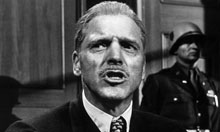
much responsibility someone held who had "just followed orders." Judgment at Nuremberg is a dramatized version of the proceedings at one of these trials, in which Judge Dan Haywood (Spencer Tracy) is overseeing the trials of four German judges — most notably Dr. Ernst Janning (Burt Lancaster) and Emil Hahn (Werner Klemperer)
— accused of knowingly sentencing innocent men to death in collusion
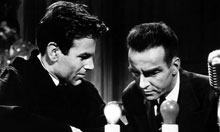
with the Nazis. Representing the defense is attorney Hans Rolfe (Maximilian Schell), while prosecuting the accused is U.S. Col. Tad Lawson (Richard Widmark).
As the trial goes on, both the visiting Americans and their reluctant
German hosts often find themselves facing the legacy of the war, and how
both of their nations have been irrevocably changed by it. Judgment at Nuremberg also features notable supporting performances by Marlene Dietrich, Judy Garland, and Montgomery Clift. Originally written and produced as a play for television, the screen version of Judgment at Nuremberg was nominated for 11 Academy Awards, with Maximilian Schell and Abby Mann taking home Oscars for (respectively) Best Actor and Best Adapted Screenplay. ~ Mark Deming, RoviADVERTISEMENT
From The Guardian:
The Nuremberg trials were a series of military tribunals carried out
by Allied forces against military and administrative officials and
private contractors of Nazi Germany. They took place between 1945 and
1949.Justice
It's 1948, and American judge Dan Haywood
(Spencer Tracy) arrives in Nuremberg. "Hitler is gone, Goebbels is gone,
Goering is gone – committed suicide before they could hang him," he
says. "Now we're down to the business of judging the doctors,
businessmen and judges. Some people think they shouldn't be judged at
all." The most attention-grabbing of the Nuremberg trials was that of the major war criminals in 1945-46. This film is about the judges' trial, which actually took place over the course of 1947. The date has been changed for a reason. Here, the trial is juxtaposed with the Czech coup of 1948 and the beginning of the cold war.Morality
During the trial, which has been fictionalised, four defendants face
three North American judges. They are defended by a German (Maximilian Schell,
who won the best actor Oscar for his performance; Tracy was also
nominated). They are prosecuted by a fire-breathing American (Richard
Widmark), traumatised by what he saw in the concentration camps. Abby Mann's screenplay tackles some of the most sensitive questions about one of the most sensitive events in history: the Nazi holocaust.
How far did responsibility go? Were high-ranking officials only obeying
orders, and if so was that reasonable? Did ordinary Germans know what
was going on? Could they have done something to stop it?ADVERTISEMENTIt's easy
to accuse most historical films of simplification – they usually have
to convey a complicated story in a limited runtime. Not this one. Only
one character in Judgment at Nuremberg comes across as straightforwardly
bad: unrepentant defendant Emil Hahn (played by Werner Klemperer, a real-life refugee from Nazi Germany). Other than him, the film doesn't make things easy for the audience.People
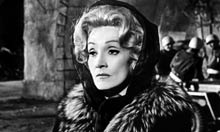
Judge Haywood's balance is thrown when he meets the enigmatic Frau
Berthold (Marlene Dietrich). She is the widow of a Nazi general who has
been executed following an earlier trial. "We hated Hitler," she tells
him. "I want you to know that. And he hated us … That's why it's so
ironic, what happened … It was political murder. You can see that, can't
you?" Her luminous performance stands out in a film filled with great
acting – including Burt Lancaster as Nazi judge Ernst Janning,
struggling painfully with his demons. Look out also for Montgomery
Clift as a victim of enforced sterilisation and Judy Garland as an Aryan
woman accused of having an affair with a Jewish man (a fictionalisation
of the Katzenberger case of 1942).
Whether as a result of their real-life troubles or not, both Clift and
Garland are extraordinarily effective playing desperate, broken,
vulnerable people.Politics
Judgment at Nuremberg provoked controversy at the time of its release, from cinematic and political critics alike. "People asked how could I, an American, try to rekindle German guilt?" said director Stanley Kramer. "Well, I said that it would indeed have been better if the Germans had made it, but the fact is they didn't. So I did."
One
of the reasons why the film stands up well after 50 years is that
Kramer also resisted making his own compatriots the heroes. Preoccupied
with the Czech coup and the cold war, an American general joins those
encouraging Haywood to prioritise reconciliation over justice in the
name of patriotism – a supposed virtue that does not emerge at all well
from this movie. Indeed, the awkward and compromising position of
American occupiers resonates even more deeply half a century after the
film was made.Verdict
ADVERTISEMENTJudgment at Nuremberg doesn't stick precisely to the facts of the
judges' trial, but its fictionalisations are intelligent. It raises
complex questions, resists easy answers, and leaves the viewer keen to
think and know more. For those reasons, it's an exceptionally good
historical film – and a haunting one.

The Truth Must be Told
Your contribution supports independent journalism
Please take a moment to consider this. Now, more than ever, people are reading Geller Report for news they won't get anywhere else. But advertising revenues have all but disappeared. Google Adsense is the online advertising monopoly and they have banned us. Social media giants like Facebook and Twitter have blocked and shadow-banned our accounts. But we won't put up a paywall. Because never has the free world needed independent journalism more.
Everyone who reads our reporting knows the Geller Report covers the news the media won't. We cannot do our ground-breaking report without your support. We must continue to report on the global jihad and the left's war on freedom. Our readers’ contributions make that possible.
Geller Report's independent, investigative journalism takes a lot of time, money and hard work to produce. But we do it because we believe our work is critical in the fight for freedom and because it is your fight, too.
Please contribute here.

or
Make a monthly commitment to support The Geller Report – choose the option that suits you best.
ADVERTISEMENT
Quick note: We cannot do this without your support. Fact. Our work is made possible by you and only you. We receive no grants, government handouts, or major funding.Tech giants are shutting us down. You know this. Twitter, LinkedIn, Google Adsense, Pinterest permanently banned us. Facebook, Google search et al have shadow-banned, suspended and deleted us from your news feeds. They are disappearing us. But we are here.
Subscribe to Geller Report newsletter here— it’s free and it’s essential NOW when informed decision making and opinion is essential to America's survival. Share our posts on your social channels and with your email contacts. Fight the great fight.
Follow Pamela Geller on Gettr. I am there. click here.
Follow Pamela Geller on Trump's social media platform, Truth Social. It's open and free.
Remember, YOU make the work possible. If you can, please contribute to Geller Report.
Join The Conversation. Leave a Comment.
We have no tolerance for comments containing violence, racism, profanity, vulgarity, doxing, or discourteous behavior. If a comment is spammy or unhelpful, click the ... symbol to the right of the comment to let us know. Thank you for partnering with us to maintain fruitful conversation.