[ April 17, 2026 ]
Today’s Democratic party is not the Democratic party of our parents or grandparents.
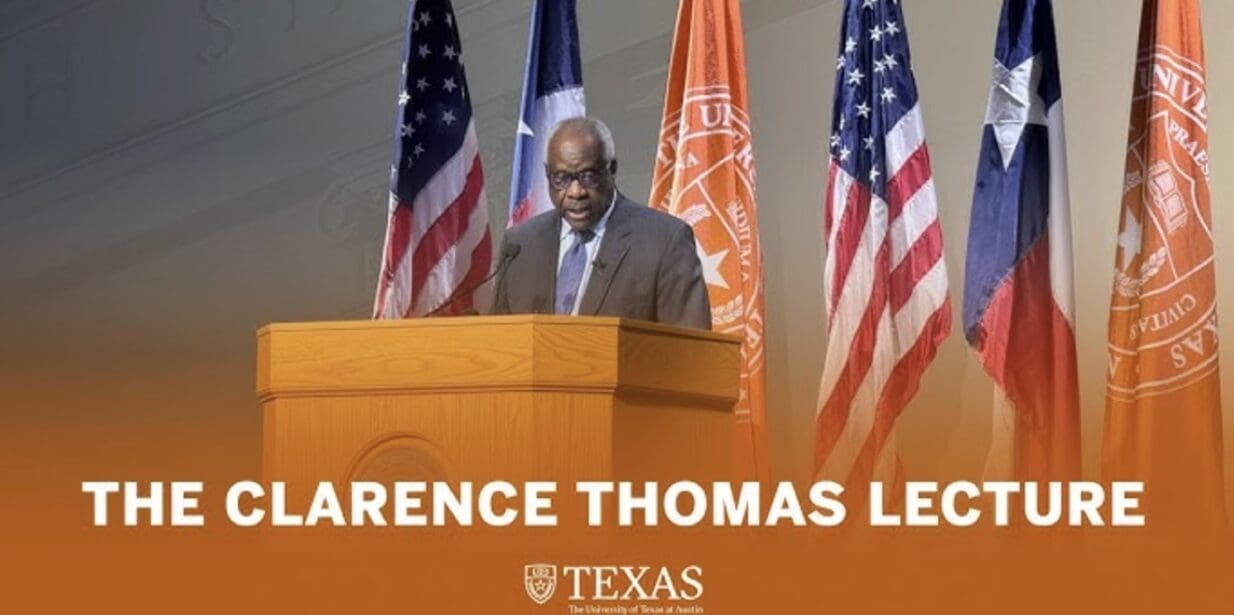
The superb Supreme Court Justice highlights what is at jeopardy as one of only two major political parties embraces progressivism. Washington Examiner: He warned that it is “unclear” if the founding principles of limited government and individual rights will endure, pointing to the rise of progressivism, which began during Woodrow Wilson’s presidency in the 1910s…. “Since Wilson’s presidency, progressivism has made many inroads into our system of government and our way of life,” Thomas said. “It has coexisted uneasily with the principles of the declaration, because it is opposed to those principles. It is not possible for the two to coexist forever.” … “Progressivism seeks to replace the basic premises of the Declaration of Independence and hence, our form of government,” Thomas said. “It holds that our rights and our dignities come not from God, but from government. It requires of the people a subservience and weakness incompatible with a constitution premised on the transcendent origin of our rights (Washington Examiner).
A Republic Needs Courage, Not Just Words
ADVERTISEMENT
As the nation approaches the 250th anniversary of the Declaration of Independence, we are not suffering from a shortage of ideas. We are suffering from a shortage of conviction.
The principles of the Declaration are not abstractions. They are not academic exercises reserved for classrooms and conferences. They are a way of life. They assert a simple, radical truth: that our rights come from God—not from government—and that government exists to protect those rights, not grant them.
For generations, Americans understood this instinctively. Even in the face of injustice, even when the promises of the Constitution were denied, there remained a deep and unshakable belief that equality was real—that it was inherent, not bestowed. That belief sustained people through circumstances that should have extinguished it.
Today, that certainty is eroding. In its place: cynicism, hostility, and a growing tendency to treat our founding principles as negotiable—or worse, obsolete.
But the danger is not merely intellectual. It is moral.
ADVERTISEMENT
In Washington, and across public life, there is no shortage of people who can recite the right words. They speak of liberty, equality, and constitutional fidelity. They write essays, deliver speeches, and signal virtue. But when tested—when those principles demand sacrifice—too many retreat.
They fear criticism. They crave approval. They trade conviction for comfort.
This is not new. It has always been easier to say the right thing than to do it. The tragedy is not that people fail to understand what is right—it is that too few are willing to pay the price to uphold it.
The authors of the Declaration did not merely articulate principles. They pledged everything to them—“our lives, our fortunes, and our sacred honor.” That final sentence is not ornamental. It is the entire point.
Without that commitment, the rest are just words on parchment.
That same devotion carried a nation through its greatest trials—through war, through division, through the long struggle to reconcile its ideals with its realities. It is what allowed those ideals to endure, even when they were imperfectly applied.
And it is precisely what is missing now.
ADVERTISEMENT
We are tempted to treat the Declaration as a relic—something to commemorate, to debate, to admire at a distance. We gather, we speak, we analyze. But too often, we stop short of the one thing that matters: living it.
A republic cannot survive on rhetoric alone. It requires citizens willing to stand firm when it is inconvenient, to speak when it is unpopular, to act when it is costly.
Courage is not theoretical. It is a habit.
It is found in the small decisions: refusing to repeat a lie, standing against fashionable intolerance, holding to principle when it costs you friends, status, or opportunity. These are not dramatic acts, but they are decisive ones.
The question is not whether we understand the Declaration. The question is whether we are willing to defend it.
If we are not—if we lack the resolve to match the courage of those who founded and preserved this country—then no amount of scholarship, no refinement of theory, will save it.
The future of the republic depends not on what we say about our principles, but on what we are willing to do for them.
The choice is the same now as it was in 1776.
Words—or commitment.
Notable quotes:
- “A republic cannot survive on rhetoric alone.”
- “The crisis is not intellectual—it is moral.”
- “They speak the words—but abandon the cost.”
- “Without commitment, the Declaration is just ink on paper.”
- “Too many know what is right. Too few will pay for it.”
- “Principles that cost nothing are worth nothing.”
- “Courage—not consensus—is what sustains a nation.”
- “The Founders didn’t debate the Declaration—they bled for it.”
- “What we lack is not knowledge, but nerve.”
- “The question is not what we believe—it’s what we’ll risk.”
Op-Ed: A Republic Needs Courage, Not Just Words
As the nation approaches the 250th anniversary of the Declaration of Independence, we are not suffering from a shortage of ideas. We are suffering from a shortage of conviction.
The principles of the Declaration are not abstractions. They are not academic exercises reserved for classrooms and conferences. They are a way of life. They assert a simple, radical truth: that our rights come from God—not from government—and that government exists to protect those rights, not grant them.
For generations, Americans understood this instinctively. Even in the face of injustice, even when the promises of the Constitution were denied, there remained a deep and unshakable belief that equality was real—that it was inherent, not bestowed. That belief sustained people through circumstances that should have extinguished it.
Today, that certainty is eroding. In its place: cynicism, hostility, and a growing tendency to treat our founding principles as negotiable—or worse, obsolete.
But the danger is not merely intellectual. It is moral.
In Washington, and across public life, there is no shortage of people who can recite the right words. They speak of liberty, equality, and constitutional fidelity. They write essays, deliver speeches, and signal virtue. But when tested—when those principles demand sacrifice—too many retreat.
They fear criticism. They crave approval. They trade conviction for comfort.
This is not new. It has always been easier to say the right thing than to do it. The tragedy is not that people fail to understand what is right—it is that too few are willing to pay the price to uphold it.
The authors of the Declaration did not merely articulate principles. They pledged everything to them—“our lives, our fortunes, and our sacred honor.” That final sentence is not ornamental. It is the entire point.
Without that commitment, the rest are just words on parchment.
That same devotion carried a nation through its greatest trials—through war, through division, through the long struggle to reconcile its ideals with its realities. It is what allowed those ideals to endure, even when they were imperfectly applied.
And it is precisely what is missing now.
We are tempted to treat the Declaration as a relic—something to commemorate, to debate, to admire at a distance. We gather, we speak, we analyze. But too often, we stop short of the one thing that matters: living it.
A republic cannot survive on rhetoric alone. It requires citizens willing to stand firm when it is inconvenient, to speak when it is unpopular, to act when it is costly.
Courage is not theoretical. It is a habit.
It is found in the small decisions: refusing to repeat a lie, standing against fashionable intolerance, holding to principle when it costs you friends, status, or opportunity. These are not dramatic acts, but they are decisive ones.
The question is not whether we understand the Declaration. The question is whether we are willing to defend it.
If we are not—if we lack the resolve to match the courage of those who founded and preserved this country—then no amount of scholarship, no refinement of theory, will save it.
The future of the republic depends not on what we say about our principles, but on what we are willing to do for them.
The choice is the same now as it was in 1776.
Words—or commitment.
Justice Clarence Thomas – University of Texas Speech
Thank you. Thank you. Well, I think I’ll quit while I’m ahead. Thank you all very much.
President Davis, Provost Bowden, Dean Dyer, faculty, students, and honored guests—I thank each of you for being here, and I thank the school and the officials here for the invitation to visit the University of Texas at Austin.
My wife Virginia and I are pleased to be here and to celebrate the 250th anniversary of the Declaration of Independence.
If my memory serves me, this is only my second visit to the University of Texas, and this is the first visit at the invitation of the university. But I have hired and worked with a number of outstanding young people associated with this university.
My first was now Chief Judge Greg Maggs of the U.S. Court of Appeals for the Armed Services, who was a fairly new faculty member at the law school when I became a member of the Court. He took a leave of absence to help me as a law clerk during the second half of my first term.
My first UT graduate to serve as a law clerk was Greg Coleman, three decades ago. Greg went on to become the first Solicitor General of the state of Texas. He was simply outstanding, as was his son Reed, who also was a graduate of the law school here and who was equally outstanding.
Greg’s widow and our very dear friend Stephanie is with us today. Stephanie, thank you—and thank you for being such a good friend.
Both Greg and his son Reed clerked for my dear friend Judge Edith Jones, also a graduate of UT Law School. I greatly admire Judge Jones. She is one of my heroes, and I admire her as a person and as a jurist, and I’m grateful that she can be here today.
A number of my former clerks are also here. I can’t tell you which ones, so let me ask them to stand to be recognized.
So in my chambers, UT and UT Law School are very well represented.
I hope that my talk today will help in some small way to inaugurate another great initiative—the state of Texas’s plan to restore the teaching of civics and Western civilization to a central place in its flagship university.
I am grateful and honored to have been invited by Justin Dyer, the dean of the new School of Civic Leadership. I’m also grateful for the assistance of my former law clerk, Professor John Yoo, who has spent the last three decades at Berkeley Law School but is now joining Justin and his team here at the University of Texas.
The school’s stated mission is to help students encounter the distinct inheritance of Western civilization and the American constitutional tradition as part of a larger quest for wisdom about how to live and how to lead.
Your plans could not come at a more important moment for our nation, when, as we celebrate the 250th anniversary of the Declaration of Independence, the very values announced in it have fallen out of favor.
It is my sincere hope that your work to revitalize the teaching and research of Western civilization and the American constitutional tradition will lead the way in the reform of our nation’s colleges and universities. And I hope that your example will help to rejuvenate our fellow citizens’ commitment to the principles of the Declaration of Independence.
I always enjoy my travels to this amazing state. My wife Virginia and I have many wonderful friends and acquaintances here, and it is so special to have our dear friends H. Harlon and Kathy Crow join us today.
One of the features of this state that stands out is the way Texans talk about it. What comes through is the sustained and sustaining affection they have for their home state.
That reverential feeling for and attachment to Texas is to be respected and admired—and, if possible, emulated.
This affection is similar to the attachment that I grew to have for my home state of Georgia, and certainly for our country, despite the indelible mark of segregation and its companion evils.
I was proud to say that I was American by birth and Georgian by the grace of God.
It was not uncommon to hear others openly proclaim their allegiance to God and country.
At our grammar school, St. Benedict’s, we started each school day by lining up two by two in the schoolyard to watch the raising of our flag and to say the Pledge of Allegiance before silently marching to our respective classrooms.
Even as so much of our God-given and constitutional rights were denied us, we still faithfully said the pledge, memorized the preamble to the Constitution, and yearned for the fulfillment of its promised ideals.
Sadly, these sentiments are not as widely shared among our fellow citizens today, and they certainly do not seem to have that sustaining strength that they had back then.
All too often, the sentiments tend toward cynicism, rejection, hostility, and animus toward our country and its ideals.
With that in mind, I would like to begin by addressing my first encounter with the principles of the Declaration of Independence.
It is perhaps not what you would immediately think.
The second paragraph of the Declaration proclaims:
“We hold these truths to be self-evident, that all men are created equal, that they are endowed by their Creator with certain unalienable rights.”
Throughout my youth, these truths were articles of faith that were impervious to bigotry and discrimination.
They were the north star—the rock—immovable and unquestioned.
Despite the multiplicity of laws and customs that reinforced bigotry, it was universally believed among those with whom I lived—many with little or no formal education—that in God’s eyes and under our Constitution, we were equal.
At home, at school, and at church, we were taught that we are inherently equal—that equality comes from God, and that it cannot be diminished by man.
Others could treat us as unequal, but they lacked the power to make us so.
When you lived in a segregated world, it was obvious that your dignity did not come from government—but from God.
That understanding shaped everything.
The principles of the Declaration are not abstract theories. They are a way of life.
They are not something you only learn in law school—they are truths you learn from the people around you.
I believe now, as I did then, that the Declaration of 1776 provides us with the principles to guide us as citizens of our republic.
Despite our imperfections, it gave us the freest, wealthiest, and most powerful nation in history.
It provided the moral foundation for those who challenged slavery and segregation.
It made clear that the purpose of government is to protect our God-given rights.
But none of it matters without the final sentence—the commitment:
“We mutually pledge to each other our lives, our fortunes, and our sacred honor.”
That is what gave those words power.
That devotion—willingness to sacrifice—is what built this country.
And it is that devotion, I believe, that is missing today.
In Washington, I have seen no shortage of people who speak noble words—but too often, it is only words.
When tested, many retreat—out of fear, ambition, or comfort.
Too few are willing to sacrifice for principle.
That is why our institutions falter—not from lack of knowledge, but lack of courage.
I have faced that test myself.
And I concluded then, as I do now:
Our principles are worth everything.
They are worth life itself.
Those principles are simple:
We are equal.
Our rights come from God—not government.
Government exists to protect those rights—not grant them.
That is the foundation of our Constitution.
Today, those principles are under challenge.
New ideas—particularly progressivism—seek to replace them with a system where rights come from government.
History shows us where that leads.
The great tragedies of the 20th century were built on those ideas.
The Declaration remains our safeguard.
It is final.
As Calvin Coolidge said:
“If all men are created equal, that is final.”
The question is whether we still have the courage to defend it.
Lincoln understood this at Gettysburg—that devotion must be renewed.
And that is the challenge before us now.
Do we have the courage to stand?
Not in grand gestures—but in daily choices:
To speak truth.
To resist pressure.
To stand firm when it costs something.
That is how a republic is preserved.
Courage is habit-forming—just like cowardice.
And it is liberating.
So celebrate the Declaration.
But more importantly—live it.
Defend it.
Commit yourselves to it.
And with a firm reliance on divine providence, let us mutually pledge to each other:
Our lives,
our fortunes,
and our sacred honor.
Thank you—and may God bless our country.
The Truth Must be Told
Your contribution supports independent journalism
Please take a moment to consider this. Now, more than ever, people are reading Geller Report for news they won't get anywhere else. But advertising revenues have all but disappeared. Google Adsense is the online advertising monopoly and they have banned us. Social media giants like Facebook and Twitter have blocked and shadow-banned our accounts. But we won't put up a paywall. Because never has the free world needed independent journalism more.
Everyone who reads our reporting knows the Geller Report covers the news the media won't. We cannot do our ground-breaking report without your support. We must continue to report on the global jihad and the left's war on freedom. Our readers’ contributions make that possible.
Geller Report's independent, investigative journalism takes a lot of time, money and hard work to produce. But we do it because we believe our work is critical in the fight for freedom and because it is your fight, too.
Please contribute here.

or
Make a monthly commitment to support The Geller Report – choose the option that suits you best.
ADVERTISEMENT
Quick note: We cannot do this without your support. Fact. Our work is made possible by you and only you. We receive no grants, government handouts, or major funding.Tech giants are shutting us down. You know this. Twitter, LinkedIn, Google Adsense, Pinterest permanently banned us. Facebook, Google search et al have shadow-banned, suspended and deleted us from your news feeds. They are disappearing us. But we are here.
Subscribe to Geller Report newsletter here— it’s free and it’s essential NOW when informed decision making and opinion is essential to America's survival. Share our posts on your social channels and with your email contacts. Fight the great fight.
Follow Pamela Geller on Gettr. I am there. click here.
Follow Pamela Geller on Trump's social media platform, Truth Social. It's open and free.
Remember, YOU make the work possible. If you can, please contribute to Geller Report.
Join The Conversation. Leave a Comment.
We have no tolerance for comments containing violence, racism, profanity, vulgarity, doxing, or discourteous behavior. If a comment is spammy or unhelpful, click the ... symbol to the right of the comment to let us know. Thank you for partnering with us to maintain fruitful conversation.