
[ November 17, 2026 ]
In 2000, the American presidency came down to 537 votes in a single state. The nation survived that crisis because the legal battle stayed inside Florida while the rest of the country certified its results cleanly. Now imagine that same razor-thin margin spread across more than 3,000 counties simultaneously – a nationwide recount where every precinct becomes a courtroom and every ballot triggers litigation.
That single contrast captures the vital truth about the Electoral College. It stands as the constitutional anchor that keeps the United States a federal republic rather than a centralized majoritarian democracy.
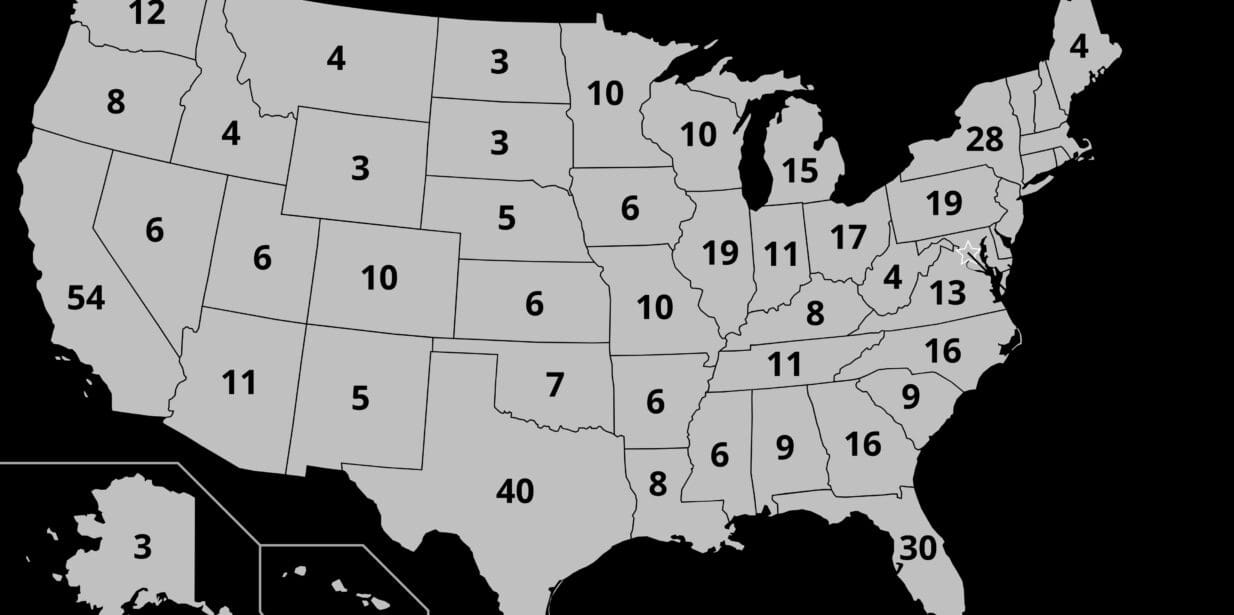
America is a union of sovereign states, not a single undifferentiated mass of voters. Under Article II of the Constitution and the Twenty-Third Amendment, the nation conducts 51 separate executive elections – one in each of the 50 states plus the District of Columbia – for a total of 538 electoral votes. Each state receives electors equal to its House delegation plus two senators, while the District of Columbia receives three. This formula mirrors the Great Compromise that created the United States Congress, where population governs the House of Representatives and equal statehood governs the Senate.
ADVERTISEMENT
This structure forces any serious presidential contender to build a broad, trans-regional coalition. Because winner-take-all rules in 48 states award zero extra credit for running up massive margins in a single city or region, a candidate cannot capture the White House by dominating coastal metropolises alone. To reach the mandatory threshold of 270 electoral votes, a campaign must assemble support across divergent economic and cultural regions – from the industrial Midwest and the Sun Belt to the Mountain West and the Atlantic coast.
Abolitionists attack this architecture on several fronts, yet every objection overlooks the deeper republican safeguards the system provides.
First, opponents point to popular-vote mismatches. Four times in American history – in 1876, 1888, 2000, and 2016 – the Electoral College winner lost the national popular vote, while a fifth president, John Quincy Adams in 1824, entered office through a House contingent election after losing both tallies in a race where six states still appointed electors through their legislatures. Popular-vote advocates treat these outcomes as democratic failures, yet they misunderstand the constitutional contest. Just as the World Series crowns the team that wins four games rather than the team that scores the most total runs, the American presidency belongs to the leader who wins a majority of state-allocated electoral votes.
Second, theorists condemn unequal vote weight. Because every state receives a two-elector senatorial floor regardless of population, an individual voter in Wyoming commands greater mathematical weight in the Electoral College than a voter in California. Opponents call this unfair, yet this exact mechanism preserves federalism. Without that small-state floor, high-density media markets and urban corridors dictate national policy while rural and less-populous states lose all executive leverage.
Third, reformers argue that modern practice departs from the Founders’ design. While James Madison warned against the tyranny of majority factions in Federalist No. 10, Alexander Hamilton defended the Electoral College specifically in Federalist No. 68 as a safeguard against tumult, disorder, and foreign influence. Watchdogs note that Hamilton envisioned electors as independent deliberative judges, whereas today over 99 percent of electors vote strictly as pledged to their party nominees. They also point out that the original allocation formula incorporated the Three-Fifths Compromise, which inflated the electoral clout of slaveholding states before the Fourteenth Amendment erased that stain. Even as political parties transformed how electors operate, the state-by-state structure continues to perform its core constitutional job: it decentralizes executive power and forces national consensus.
ADVERTISEMENT
Fourth, opponents contend that winner-take-all rules already concentrate attention on a handful of battleground states – noting cycles such as 2016, when 94 percent of general-election campaign events occurred in just 12 states – and warn that razor-thin margins in one state magnify local disputes into national crises. Yet a national popular vote solves neither problem. Instead of campaigning in diverse swing states across multiple regions, candidates pour their money exclusively into the nation’s largest television markets and most densely populated metropolitan hubs. Meanwhile, the 2000 Florida recount proves the value of containment: even when a single state becomes a legal battleground, state borders wall off the chaos and protect the legitimacy of the final transfer of power.
The Electoral College demands broad geographic consensus, protects smaller states from urban domination, and isolates electoral disputes before they fracture the union. To dismantle this institution is to strip statehood from the executive branch and convert a constitutional republic into an unchecked central majoritarian state. For more than two centuries, 538 electors across 51 jurisdictions have delivered peaceful transitions of power across a vast continent – and no alternative matches its record of keeping the American union intact.
\
The Truth Must be Told
Your contribution supports independent journalism
Please take a moment to consider this. Now, more than ever, people are reading Geller Report for news they won't get anywhere else. But advertising revenues have all but disappeared. Google Adsense is the online advertising monopoly and they have banned us. Social media giants like Facebook and Twitter have blocked and shadow-banned our accounts. But we won't put up a paywall. Because never has the free world needed independent journalism more.
Everyone who reads our reporting knows the Geller Report covers the news the media won't. We cannot do our ground-breaking report without your support. We must continue to report on the global jihad and the left's war on freedom. Our readers’ contributions make that possible.
Geller Report's independent, investigative journalism takes a lot of time, money and hard work to produce. But we do it because we believe our work is critical in the fight for freedom and because it is your fight, too.
Please contribute here.

or
Make a monthly commitment to support The Geller Report – choose the option that suits you best.
ADVERTISEMENT
Quick note: We cannot do this without your support. Fact. Our work is made possible by you and only you. We receive no grants, government handouts, or major funding.Tech giants are shutting us down. You know this. Twitter, LinkedIn, Google Adsense, Pinterest permanently banned us. Facebook, Google search et al have shadow-banned, suspended and deleted us from your news feeds. They are disappearing us. But we are here.
Subscribe to Geller Report newsletter here— it’s free and it’s essential NOW when informed decision making and opinion is essential to America's survival. Share our posts on your social channels and with your email contacts. Fight the great fight.
Follow Pamela Geller on Gettr. I am there. click here.
Follow Pamela Geller on Trump's social media platform, Truth Social. It's open and free.
Remember, YOU make the work possible. If you can, please contribute to Geller Report.
Join The Conversation. Leave a Comment.
We have no tolerance for comments containing violence, racism, profanity, vulgarity, doxing, or discourteous behavior. If a comment is spammy or unhelpful, click the ... symbol to the right of the comment to let us know. Thank you for partnering with us to maintain fruitful conversation.





recent Comments