
[ November 16, 2026 ]
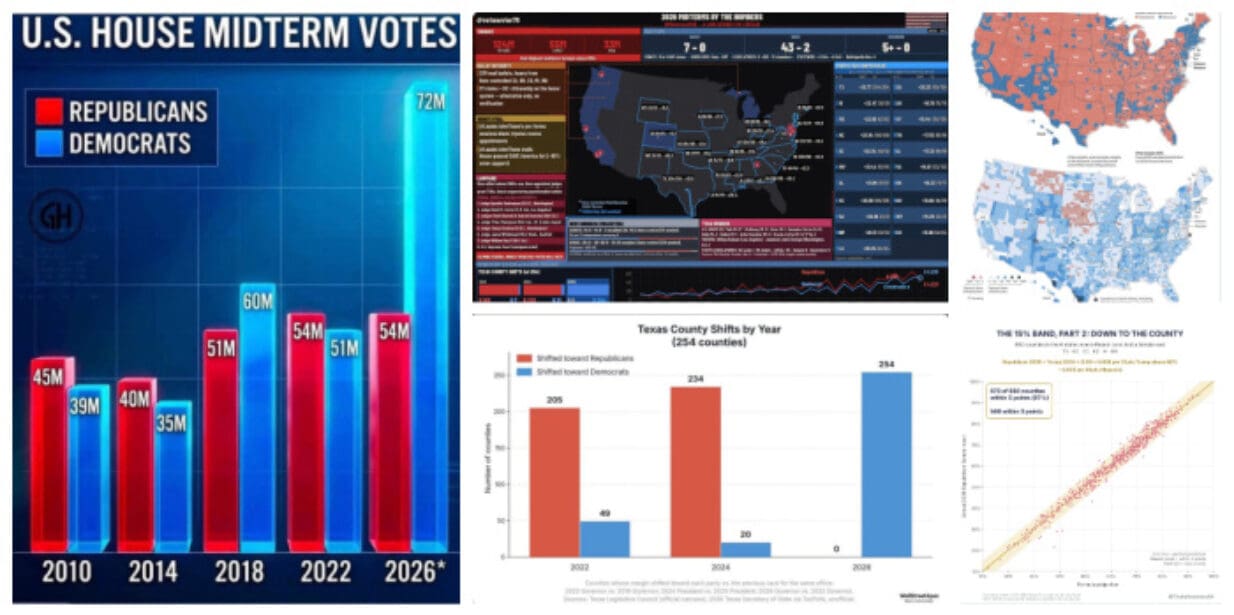
The November 2026 midterms did not deliver clean results. They delivered a cascade of red flags that any honest observer must confront. This left many Americans questioning whether the results truly reflected the will of the voters. Federal data, documented cases, Election Day failures, mail-in anomalies, and viral evidence of irregularities form a pattern that cannot be dismissed as isolated human error. Federal agencies themselves documented the scale of the problem. The Department of Homeland Security reported more than 1,600 active voter fraud investigations, over 150 arrests, and roughly 300,000 suspicious records under review in the run-up to the election. A million-dollar reward was offered for tips. These are not the statistics of a secure system. They are the statistics of a system under siege.
The Heritage Foundation’s database of proven election fraud cases – more than 1,500 documented instances and over 1,300 criminal convictions – shows this is not a new phenomenon. It is a long-standing vulnerability that federal authorities were still racing to contain as voters went to the polls. When hundreds of thousands of records are flagged through cross-checks of voter rolls, immigration data, and state files, the claim that “nothing is happening” collapses. An automated flag is not yet a conviction, but 1,620 formal inquiries nationwide is not clerical noise. It is a warning.
Election Day itself exposed the machinery’s fragility at the worst possible moments. In Westchester County, New York, during the razor-thin congressional race between Mike Lawler and Cait Conley, optical scanners suddenly stopped accepting Election Day ballots. Republicans vote heavily on Election Day. The machines failed precisely when those ballots were being cast. Officials blamed a programming update that created a formatting mismatch with the printed ballots. Voters were told to drop their paper into emergency compartments. The optics were disastrous: in a competitive district, the very systems designed to count votes rejected the votes of one side’s strongest turnout method. Similar failures and “glitches” appeared elsewhere. Videos from multiple states captured touchscreens flipping candidate selections when voters tapped them. Capacitive screens can lose calibration. Knuckles can brush edges. But the pattern of these failures occurring in high-stakes races is what demands explanation, not dismissal.
ADVERTISEMENT
The software behind these machines compounds the distrust. Companies such as Liberty Vote – formerly Dominion – run proprietary code that the public cannot inspect. Rumors of vendor influence, remote access capabilities, and past controversies refuse to die. Officials insist the machines are air-gapped and subjected to Logic and Accuracy tests. They insist post-election audits of paper batches provide the final check. Yet when the same systems produce sudden rejections and screen flips at critical moments, confidence evaporates. Software can be tested. It can also be compromised. The public is asked to trust black-box systems whose vendors have faced years of suspicion.
Mail-in voting supplied the most dramatic shifts. Across California and multiple swing states, candidates who led on Election Night watched their leads disappear as batch after batch of mail-in ballots arrived over subsequent days and nights. The so-called “blue shift” is presented as a natural result of processing rules that delay the opening and scanning of mail ballots. Signature verification takes time. Flattening and review take time. But the consistent directional effect – late ballots moving races in one direction – creates the appearance of a system that can be gamed by volume and timing. Viral video from Ventura County showed mail-in envelopes punched with two holes. Critics correctly noted that those holes could allow workers to see how ballots were marked and selectively discard them. Officials offered explanations about tactile orientation for the visually impaired and empty-envelope checks. The public saw a process that invited abuse.
Concentrated registrations at commercial mail facilities have long been a red flag for fraud investigators. Ballot harvesting – paid operatives collecting stacks of mail ballots from nursing homes, apartment complexes, and other high-density locations – remains legal in too many jurisdictions. Unique barcodes and signature matching are cited as safeguards. Those safeguards still leave room for pressure, coercion, and selective delivery of harvested ballots into drop boxes.
Online platforms and comment sections filled with firsthand accounts from poll watchers, statistical charts showing suspiciously uniform shift bands, and reports of major seizures, including claims of an FBI raid on a Houston warehouse containing 20,000 fake ballots. Courts demand physical evidence under oath and reject volume of online reports as insufficient. That legal standard protects against frivolous challenges. It also leaves unresolved the widespread perception – fueled by federal investigation numbers, machine failures timed to Election Day voting, late-night ballot dumps, and registration anomalies – that the system failed to deliver transparent, trustworthy results.
Administrative friction is real. Printers jam. Programming updates fail. Mail processing stretches for days. Those are not imaginary problems. They are the exact points of vulnerability that allow errors – or worse – to affect outcomes. When the same friction repeatedly disadvantages one side’s preferred voting method, when federal agencies are investigating thousands of cases while offering cash rewards for tips, and when the public watches leads evaporate under late mail-in batches, the conclusion is unavoidable: the 2026 midterms were compromised. The safeguards that exist on paper did not prevent the patterns that now define the election. Americans who demand cleaner elections are not conspiracy theorists. They are citizens who can add.
ADVERTISEMENT
The Truth Must be Told
Your contribution supports independent journalism
Please take a moment to consider this. Now, more than ever, people are reading Geller Report for news they won't get anywhere else. But advertising revenues have all but disappeared. Google Adsense is the online advertising monopoly and they have banned us. Social media giants like Facebook and Twitter have blocked and shadow-banned our accounts. But we won't put up a paywall. Because never has the free world needed independent journalism more.
Everyone who reads our reporting knows the Geller Report covers the news the media won't. We cannot do our ground-breaking report without your support. We must continue to report on the global jihad and the left's war on freedom. Our readers’ contributions make that possible.
Geller Report's independent, investigative journalism takes a lot of time, money and hard work to produce. But we do it because we believe our work is critical in the fight for freedom and because it is your fight, too.
Please contribute here.

or
Make a monthly commitment to support The Geller Report – choose the option that suits you best.
ADVERTISEMENT
Quick note: We cannot do this without your support. Fact. Our work is made possible by you and only you. We receive no grants, government handouts, or major funding.Tech giants are shutting us down. You know this. Twitter, LinkedIn, Google Adsense, Pinterest permanently banned us. Facebook, Google search et al have shadow-banned, suspended and deleted us from your news feeds. They are disappearing us. But we are here.
Subscribe to Geller Report newsletter here— it’s free and it’s essential NOW when informed decision making and opinion is essential to America's survival. Share our posts on your social channels and with your email contacts. Fight the great fight.
Follow Pamela Geller on Gettr. I am there. click here.
Follow Pamela Geller on Trump's social media platform, Truth Social. It's open and free.
Remember, YOU make the work possible. If you can, please contribute to Geller Report.
Join The Conversation. Leave a Comment.
We have no tolerance for comments containing violence, racism, profanity, vulgarity, doxing, or discourteous behavior. If a comment is spammy or unhelpful, click the ... symbol to the right of the comment to let us know. Thank you for partnering with us to maintain fruitful conversation.







recent Comments