
[ August 20, 2026 ]
Iran’s Greatest Internal and External Threats to National Sovereignty
By: Amil Imani
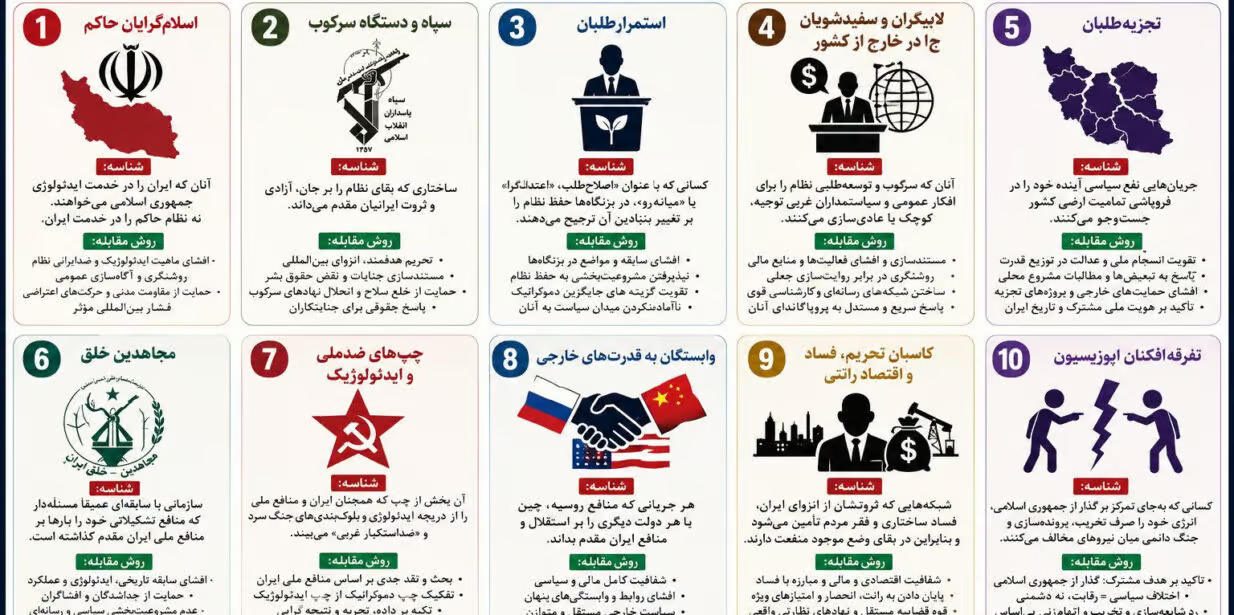
Determining which factions, governments, or movements constitute the greatest threat to a nation relies on subjective political analysis and ideological perspectives. Analysts, political theorists, and citizens view the dynamics surrounding Iran through vastly different lenses depending on their priorities regarding statehood, human rights, international relations, and governance.
ADVERTISEMENT
To understand the complex political landscape of modern Iran and the broader Middle East, observers evaluate several key internal and external actors.
To begin with, let us analyze the Internal Political Structures and Domestic Governance:
· The clerical establishment systematically diverts domestic economic reserves toward pan-Islamic expansion, starvations of national development, and ideological campaigns. Conversely, supporters view the system as a bastion of anti-imperialist sovereignty that safeguards traditional values against Western dominance.
· Security forces, including the Islamic Revolutionary Guard Corps (IRGC), command significant influence over the economy and political administration. These entities are primary agents of domestic repression and regional instability, hiding under the veneer of indispensable defenders against foreign aggression and regional chaos.
· Internal economic mismanagement, systemic corruption, and crony capitalism severely strain the national infrastructure. Internal corruption and institutional mismanagement extract the nation’s core wealth, though state authorities routinely deflect blame onto external economic sanctions.
ADVERTISEMENT
· Inside the state apparatus, elite patronage networks exploit international isolation to build vast economic monopolies. These cartels divert public assets into black-market supply lines, converting state scarcity into private financial empire. By monopolizing imports and controlling currency arbitrage, these networks extract wealth directly from the middle class. Economic survival relies on perpetual crisis; normalized trade destroys their business model. Consequently, internal beneficiaries of isolation align perfectly with external pressure, locking the population into structural poverty while securing absolute control over domestic commerce.
Turning our attention across the political spectrum, we must examine the roles played by Opposition Movements and Political Factions:
· Political elements within the established system advocating for incremental reform face intense scrutiny from multiple sides. Hardline factions view them as destabilizing compromises, whereas radical opposition groups consider them enablers who prolong the regime’s tenure under the guise of moderate governance.
· While various dissident groups operate abroad to influence international policy, the Mujahedin-e Khalq (MEK) functions as an unintended violent pillar of the regime’s control. Through its cultish internal structure, history of armed aggression, and reliance on hostile foreign patrons, the MEK acts as an effective secondary instrument of terror – providing the state with the exact existential boogeyman it requires to justify domestic brutality and suppress legitimate democratic opposition.
· Demands for greater regional autonomy among ethnic minority populations create ongoing tension. Opponents view separatist tendencies as direct threats to national sovereignty and territorial integrity, while advocates framed these movements as struggles against centralized marginalization.
· Fragmented opposition groups outside the country frequently weaponize internal divisions, prioritizing ideological purity over strategic coordination. Constant infighting transforms potential coalition platforms into sites of factional warfare. Prominent voices expend vital momentum on personal rivalries and historical grievances rather than unified pressure against the state. This perpetual fragmentation creates an informational vacuum, paralyzes collective action, and alienates domestic populations seeking a credible, organized alternative to current governance.
Expanding our scope beyond domestic boundaries, we need to evaluate the influence of International Actors and External Pressures:
ADVERTISEMENT
· External geopolitica
· Through deliberate systemic subterfuge, the clerical establishment engineers’ long-term strategic dependencies on foreign powers to safeguard its own operational survival. By tying domestic security to foreign diplomatic shields and economic bailouts, the regime consciously surrenders national sovereignty, converting the country’s strategic assets – defense procurement, maritime corridors, and trade networks – into bargaining chips for foreign patrons. This engineered reliance intentionally replaces true national self-reliance with external leverage, mortgaging long-term sovereign autonomy simply to preserve clerical dominance.
For the new future rulers, neutralizing threats to national integrity requires precise, systematic interventions across public policy, civil society, and institutional oversight:
· Mandate real-time, public tracking of all state-controlled assets, foundations, and import monopolies to exposure sanction profiteering and cut off illicit revenue channels.
· Establish independent media standards and platform guidelines that dis-incentivize bad-faith personal attacks and prioritize policy consensus among opposition factions.
· Institutionalize diplomatic protocols that prohibit political movements from accepting financial or operational backing tied to foreign intelligence services.
· Construct independent civic monitoring bodies to document human rights violations, trace illicit wealth transfers, and prepare legal frameworks for future transitional justice.
Determining whether any political entity serves the state or its own survival requires a four-part diagnostic test:
1. Does the entity maintain absolute decision-making autonomy, or does it adjust its political stance to accommodate the agendas of external patrons?
2. Do proposed economic policies direct wealth toward public infrastructure and civic welfare, or do they fortify closed institutional monopolies?
3. Does the group promote domestic self-reliance, or does it treat foreign intervention and external sanctions as acceptable trade-offs for power?
4. Does the entity respect territorial integrity and basic civil rights, or does it utilize sectarian division and violence to achieve structural control?
The ultimate metric of any political entity remains its commitment to the survival, dignity, and sovereignty of the nation itself. Systems, factions, and external actors that subordinate public welfare to ideological dogma or personal enrichment actively undermine national continuity. Securing a prosperous, self-reliant future requires strict accountability across every political tier – eradicating structural corruption, neutralizing foreign dependency, and demanding that all governance structures serve the sovereign interest of the people above all else.
The Truth Must be Told
Your contribution supports independent journalism
Please take a moment to consider this. Now, more than ever, people are reading Geller Report for news they won't get anywhere else. But advertising revenues have all but disappeared. Google Adsense is the online advertising monopoly and they have banned us. Social media giants like Facebook and Twitter have blocked and shadow-banned our accounts. But we won't put up a paywall. Because never has the free world needed independent journalism more.
Everyone who reads our reporting knows the Geller Report covers the news the media won't. We cannot do our ground-breaking report without your support. We must continue to report on the global jihad and the left's war on freedom. Our readers’ contributions make that possible.
Geller Report's independent, investigative journalism takes a lot of time, money and hard work to produce. But we do it because we believe our work is critical in the fight for freedom and because it is your fight, too.
Please contribute here.

or
Make a monthly commitment to support The Geller Report – choose the option that suits you best.
ADVERTISEMENT
Quick note: We cannot do this without your support. Fact. Our work is made possible by you and only you. We receive no grants, government handouts, or major funding.Tech giants are shutting us down. You know this. Twitter, LinkedIn, Google Adsense, Pinterest permanently banned us. Facebook, Google search et al have shadow-banned, suspended and deleted us from your news feeds. They are disappearing us. But we are here.
Subscribe to Geller Report newsletter here— it’s free and it’s essential NOW when informed decision making and opinion is essential to America's survival. Share our posts on your social channels and with your email contacts. Fight the great fight.
Follow Pamela Geller on Gettr. I am there. click here.
Follow Pamela Geller on Trump's social media platform, Truth Social. It's open and free.
Remember, YOU make the work possible. If you can, please contribute to Geller Report.
Join The Conversation. Leave a Comment.
We have no tolerance for comments containing violence, racism, profanity, vulgarity, doxing, or discourteous behavior. If a comment is spammy or unhelpful, click the ... symbol to the right of the comment to let us know. Thank you for partnering with us to maintain fruitful conversation.





recent Comments