
[ November 19, 2026 ]
In 1776, the right to overthrow a government was a founding principle. By 1787, it had become a problem to be managed. In January 1787, a column of debt-ridden farmers marched on the federal arsenal at Springfield, Massachusetts. Their leader, Daniel Shays, was a Revolutionary War veteran. State militia scattered the column and killed four of the marchers. The rebellion was over within weeks, but the alarm it set off was not.
The irony was hard to miss. Eleven years earlier, the Declaration of Independence had declared that when a government becomes destructive of the people’s rights, “it is the Right of the People to alter or to abolish it.” The idea came from John Locke, who argued in his Second Treatise that government rests on the consent of the governed. Now men who had made that argument against a king were watching their neighbors make it against them.
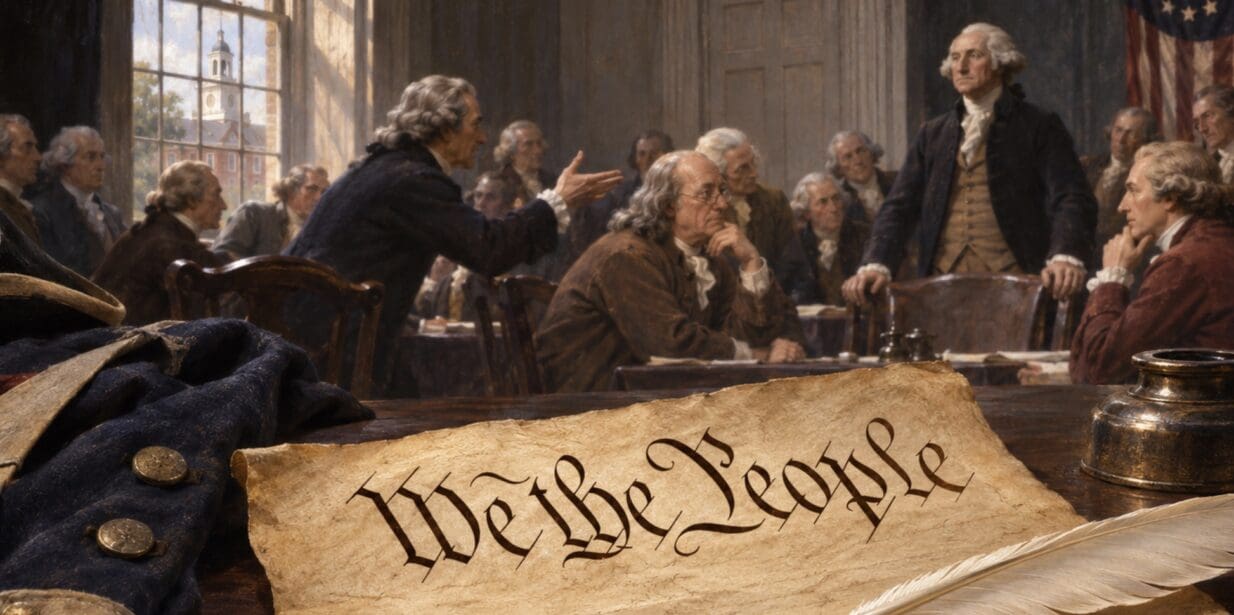
That summer, fifty-five delegates met in Philadelphia to answer a hard question: how do you build a lasting government on a founding act of rebellion?
ADVERTISEMENT
The Founders Disagreed About the Danger
Not everyone panicked. Writing from Paris, Thomas Jefferson shrugged that “a little rebellion now and then is a good thing.” George Washington, at home in Virginia, saw it differently. He feared the young republic could slip into disorder, and the news helped pull him out of retirement to preside over the convention.
The Constitution that resulted opens with “We the People.” The phrase matters. The Framers did not deny popular sovereignty. They redirected it, turning a right once exercised with muskets into one exercised through procedure.
Four Safeguards, Two Jobs
The system they built does two different things. Two features let the people change their government. Two keep any government from becoming unchangeable or unchecked.
Channels for change
- Regular elections. Voters can remove presidents and legislators on a fixed schedule, with no bloodshed and no collapse of the state.
- Article V amendments. Two-thirds of Congress, or a convention called by two-thirds of the states, can propose changes, and three-fourths of the states must ratify them. The bar is high on purpose. It has been cleared only twenty-seven times.
Limits on power
ADVERTISEMENT
- Separation of powers. Splitting authority among Congress, the presidency, and the courts means no single branch can act alone.
- Judicial review. Courts can strike down laws and actions that break the Constitution, giving citizens a way to challenge power without leaving the legal system.
Notice what is missing. Nothing in this design mentions the right to rebel. The right was not erased so much as replaced, with a promise that peaceful means would remain open.
The First Test: Whiskey and Law
The new government faced that question early. In 1794, farmers in western Pennsylvania resisted a federal excise tax on whiskey, in some cases attacking tax collectors. Washington responded by leading a militia force of roughly thirteen thousand men toward the region, and the protest dissolved before a major battle.
The message was deliberate. Under the Constitution, grievance had legitimate outlets, and armed resistance was not one of them.
Where the Law Draws the Line Today
Federal law still reflects that message. The Smith Act, now codified at 18 U.S.C. § 2385, makes it a crime to knowingly advocate overthrowing the U.S. government by force.
In practice, though, the First Amendment has narrowed that law considerably. In Brandenburg v. Ohio (1969), the Supreme Court overturned the conviction of a Ku Klux Klan leader and set a demanding test. Even radical advocacy is protected unless it is directed at inciting imminent lawless action and is likely to produce it. Under that standard, the Smith Act’s advocacy provisions are hard to enforce as written. Violence itself remains a crime. Talking about revolution, in most cases, does not.
ADVERTISEMENT
Two Rival Readings of “We the People”
Americans still disagree about where legitimate resistance ends and lawlessness begins. Two traditions in particular claim the Founders’ legacy.
The Constitutional Compact View
In this reading, the Constitution fulfilled the Revolution rather than betraying it. In his 1838 Lyceum Address, a young Abraham Lincoln, shaken by recent mob violence, urged that “reverence for the laws” become the nation’s “political religion.” On this view, popular sovereignty lives in the ballot box, in peaceful protest and civil disobedience, and in the courts. Dr. Martin Luther King Jr.’s 1963 “Letter from Birmingham Jail” is often cited as the model: breaking a law openly, accepting the penalty, and appealing to the nation’s conscience. Force, defenders argue, does not protect liberty. It silences fellow citizens.
The Citizen Vigilance View
A competing tradition reads the Constitution as a leash on the state, not a surrender of popular power. Its supporters point to Jefferson’s famous remark that the tree of liberty must be refreshed from time to time, and to the Second Amendment, which James Madison, in Federalist No. 46, tied to the idea that an armed citizenry could check a government’s ambitions. Mainstream voices in this camp reject unlawful violence. Their emphasis falls on vigilance: an informed, skeptical public is the final safeguard against abuse.
Critics of this view respond that Jefferson’s rhetoric came before the Constitution’s peaceful remedies existed, and that appeals to armed resistance now risk undermining the very system that makes dissent safe.
Living with the Tension
The Framers never resolved this disagreement, and they did not try to. They built a system where both instincts must operate in plain view. Citizens may protest, organize, and dissent loudly. But the way to change the government runs through elections, amendments, and the courts.
That bargain is the quiet achievement of 1787. It asked Americans to guard their freedom without tearing down the house that shelters it, and more than two centuries later, they are still arguing about how to keep that promise.
Sources and Further Reading
- The Declaration of Independence (1776) and the U.S. Constitution, Article V
- Thomas Jefferson, letter to James Madison, January 30, 1787
- Thomas Jefferson, letter to William Stephens Smith, November 13, 1787
- MLK Jr.’s Letter from Birmingham Jail (1963)
- Abraham Lincoln, Address to the Young Men’s Lyceum of Springfield (1838)
- Brandenburg v. Ohio, 395 U.S. 444 (1969)
- Federalist No. 46 (James Madison)
- Anthony King, The Founding Fathers v. the People (Harvard University Press, 2012)
The Truth Must be Told
Your contribution supports independent journalism
Please take a moment to consider this. Now, more than ever, people are reading Geller Report for news they won't get anywhere else. But advertising revenues have all but disappeared. Google Adsense is the online advertising monopoly and they have banned us. Social media giants like Facebook and Twitter have blocked and shadow-banned our accounts. But we won't put up a paywall. Because never has the free world needed independent journalism more.
Everyone who reads our reporting knows the Geller Report covers the news the media won't. We cannot do our ground-breaking report without your support. We must continue to report on the global jihad and the left's war on freedom. Our readers’ contributions make that possible.
Geller Report's independent, investigative journalism takes a lot of time, money and hard work to produce. But we do it because we believe our work is critical in the fight for freedom and because it is your fight, too.
Please contribute here.

or
Make a monthly commitment to support The Geller Report – choose the option that suits you best.
ADVERTISEMENT
Quick note: We cannot do this without your support. Fact. Our work is made possible by you and only you. We receive no grants, government handouts, or major funding.Tech giants are shutting us down. You know this. Twitter, LinkedIn, Google Adsense, Pinterest permanently banned us. Facebook, Google search et al have shadow-banned, suspended and deleted us from your news feeds. They are disappearing us. But we are here.
Subscribe to Geller Report newsletter here— it’s free and it’s essential NOW when informed decision making and opinion is essential to America's survival. Share our posts on your social channels and with your email contacts. Fight the great fight.
Follow Pamela Geller on Gettr. I am there. click here.
Follow Pamela Geller on Trump's social media platform, Truth Social. It's open and free.
Remember, YOU make the work possible. If you can, please contribute to Geller Report.
Join The Conversation. Leave a Comment.
We have no tolerance for comments containing violence, racism, profanity, vulgarity, doxing, or discourteous behavior. If a comment is spammy or unhelpful, click the ... symbol to the right of the comment to let us know. Thank you for partnering with us to maintain fruitful conversation.




recent Comments