
[ October 13, 2026 ]
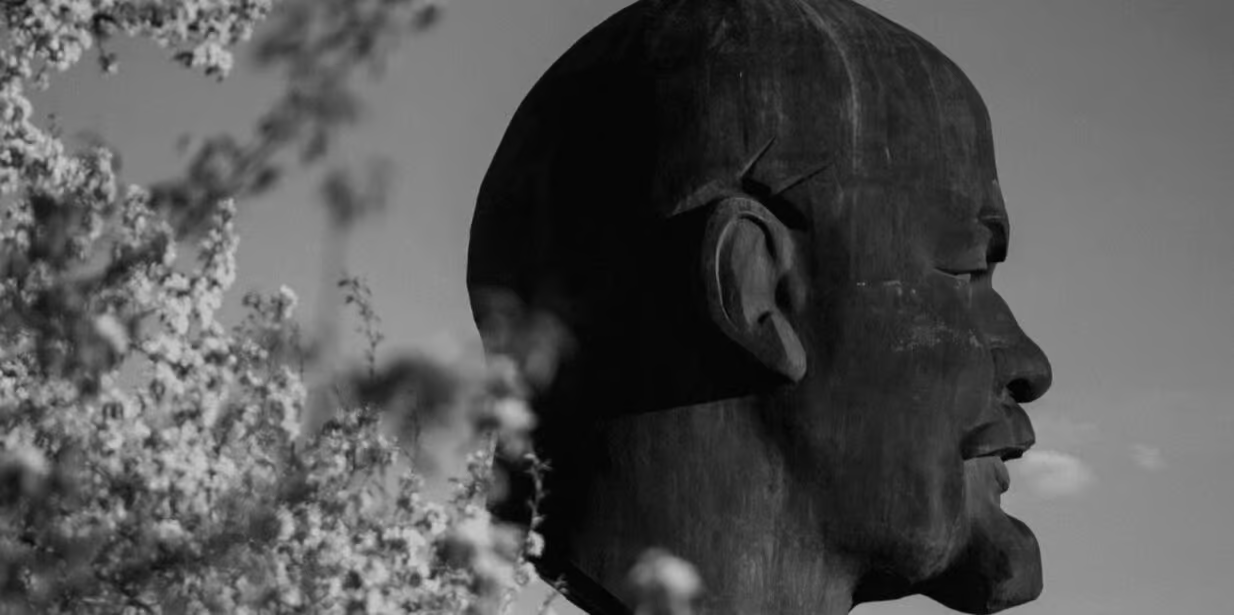
New branding, same boot. The left elite wants you obedient, dependent, and silent.
The Balloon Has Deflated: Big-Government Liberalism Runs on Borrowed Trust
By: Amil Imani
ADVERTISEMENT
Modern progressivism presents itself as the enlightened endpoint of political history: compassionate, forward-looking, and always on the right side of progress. Strip away the branding and you find something much older. It is a repackaging of twentieth-century European collectivism, with the same instinct to centralize power and manage the lives of ordinary people.
Michael Savage captured the idea with his usual bluntness: today’s left is a sausage of fascist, communist, and socialist ideas, “ground together” yet retaining the flavor of each. The metaphor is crude, but the ingredients are easy to spot:
- Coercive conformity: pressure on speech and dissent, cozy alignment between government and corporations, and relentless social engineering.
- Economic dependency: redistribution, regulatory sprawl, and a steady march toward central planning.
- Deference demanded: compliance with distant authority, wrapped in the soft language of equality.
Look at how the governing class sees the governed. In Savage’s telling, the left regards ordinary Americans as unenlightened, under-educated, overly God-worshiping suckers who can’t be trusted to run their own lives. That is the quiet premise behind a thousand mandates, guidelines, and “expert” directives.
It also explains the appeal of distraction. Savage’s charge is that the establishment is perfectly happy for you to watch the game, scroll the feed, and stay entertained rather than turn off the TV long enough to see where the power is going. You don’t have to accept the conspiracy to notice who benefits when the public stops paying attention.
Progressives insist that expansive federal power is simply what modern governance looks like. History says otherwise. In The Strange Death of American Liberalism, historian H.W. Brands argues that Americans’ faith in Washington was never permanent. It was a product of the Cold War. With a nuclear-armed Soviet Union across the ocean, the public set aside its historic suspicion of centralized power and deferred to leaders who asked for trust in the name of national security. That is the climate in which Lyndon Johnson’s Great Society took root.
ADVERTISEMENT
Then came Vietnam and Watergate. Americans learned their leaders had misled them, and the trust drained away. Brands’s image is a balloon, not a pendulum: a balloon held aloft by Cold War confidence, which deflated when that confidence collapsed, returning expectations of government to their traditional, much lower level.
Even Democrats eventually understood this. In the closing weeks of the 2000 campaign, Al Gore declared that he never wanted to see another era of big government, and that he was the candidate of limited government. When the Democratic nominee must run away from the label, the label has a problem. The modern left’s faith in unlimited federal power isn’t the natural order. It’s a hangover from an era that ended fifty years ago.
If the left is going to lecture the country about being “reality-based,” it should look at its own data. For decades, academics told us the pathology lived on the right, that conservatism was the personality of fear, rigidity, and authoritarianism. Then the corrections started arriving. The coding behind a landmark study turned out to be backwards, and the traits once pinned on conservatives, such as tough-mindedness, impulsivity, and a taste for authority, showed up more on the left. Add the consistent finding that liberals report more anxiety and less contentment, and the old story of the calm, rational progressive against the fearful reactionary looks like projection. The researchers who spent a generation diagnosing the right had the diagnosis pointed at the wrong patient.
Corrected, the data showed higher psychoticism (a trait covering tough-mindedness, impulsivity, risk-taking, and nonconformity, not clinical psychosis) among people on the left, not the right. The admission came from the American Journal of Political Science, which acknowledged that its widely cited 2012 study, built on Hans Eysenck’s personality scale, had its item coding exactly reversed. A finding that had been used for years to pathologize conservatives turned out to say the opposite.
The broader Big Five literature points the same way. Studies by Gerber and colleagues, among others, find that liberals score modestly higher on neuroticism and lower on conscientiousness. Gerber’s work links neuroticism most strongly to support for state-backed economic programs like higher taxes and government health care. The suggested mechanism is anxiety about one’s own ability to cope, and guilt toward those who struggle. Those effects are small, and they describe averages, not individuals. But they cut against the self-image of the calm, rational progressive.
The General Social Survey adds a familiar pattern: for decades, self-described conservatives have reported being happier and in better mental health than self-described liberals, with the gap widest at the far left.
The progressive project fails on three counts. It recycles old collectivist ideas under a new name. It relies on a Cold War-era trust in Washington that no longer exists. And its emotional engine runs on anxiety, not confidence.
ADVERTISEMENT
The answer isn’t to match its anxiety with anger. It’s to do what the founders assumed citizens could do: pay attention, push back, and insist on constitutional limits on state power. Personal responsibility and limited government aren’t relics. They are what a self-governing people looks like.
The Truth Must be Told
Your contribution supports independent journalism
Please take a moment to consider this. Now, more than ever, people are reading Geller Report for news they won't get anywhere else. But advertising revenues have all but disappeared. Google Adsense is the online advertising monopoly and they have banned us. Social media giants like Facebook and Twitter have blocked and shadow-banned our accounts. But we won't put up a paywall. Because never has the free world needed independent journalism more.
Everyone who reads our reporting knows the Geller Report covers the news the media won't. We cannot do our ground-breaking report without your support. We must continue to report on the global jihad and the left's war on freedom. Our readers’ contributions make that possible.
Geller Report's independent, investigative journalism takes a lot of time, money and hard work to produce. But we do it because we believe our work is critical in the fight for freedom and because it is your fight, too.
Please contribute here.

or
Make a monthly commitment to support The Geller Report – choose the option that suits you best.
ADVERTISEMENT
Quick note: We cannot do this without your support. Fact. Our work is made possible by you and only you. We receive no grants, government handouts, or major funding.Tech giants are shutting us down. You know this. Twitter, LinkedIn, Google Adsense, Pinterest permanently banned us. Facebook, Google search et al have shadow-banned, suspended and deleted us from your news feeds. They are disappearing us. But we are here.
Subscribe to Geller Report newsletter here— it’s free and it’s essential NOW when informed decision making and opinion is essential to America's survival. Share our posts on your social channels and with your email contacts. Fight the great fight.
Follow Pamela Geller on Gettr. I am there. click here.
Follow Pamela Geller on Trump's social media platform, Truth Social. It's open and free.
Remember, YOU make the work possible. If you can, please contribute to Geller Report.
Join The Conversation. Leave a Comment.
We have no tolerance for comments containing violence, racism, profanity, vulgarity, doxing, or discourteous behavior. If a comment is spammy or unhelpful, click the ... symbol to the right of the comment to let us know. Thank you for partnering with us to maintain fruitful conversation.







recent Comments