
[ August 27, 2026 ]
The 2020 election was a coup. We watched it happening in real time. Voting machines are hackable and unreliable and vulnerable to foreign interference. We must go back to paper ballots.
Homeland Security warns of Chinese parts in election machines, will require paper ballot audits
The Department of Homeland Security is mandating random paper ballot audits for upcoming elections, citing significant security risks posed by Chinese-manufactured components in widely-used voting machines.
By Just The News, August 27, 2026:
>
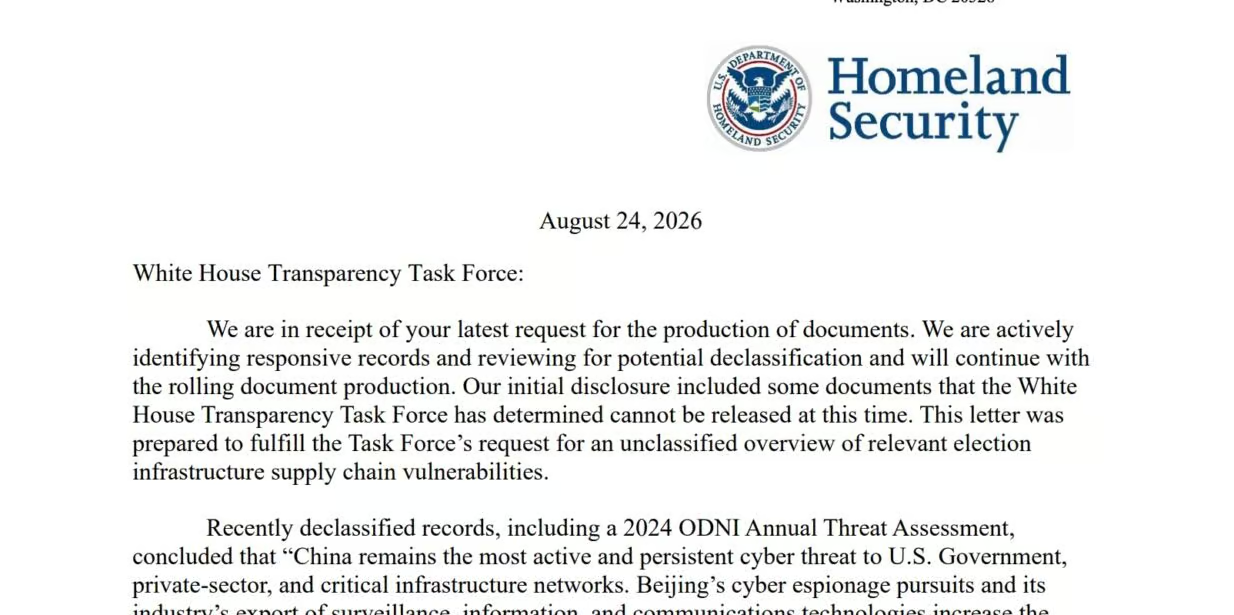
The Homeland Security Department will require random audits of paper ballots in the midterm elections, citing long-simmering concern that the nation’s largest voting technology companies use Chinese parts in their voting machines, according to a letter from Secretary Markwayne Mullin released Thursday.ADVERTISEMENTMullin sent the letter to the White House Transparency Task Force earlier this week outlining the dangers posed by Chinese components in American voting machines and the way that these components could be exploited by hackers or other malicious actors.
The letter highlighted longstanding concerns first raised in a bipartisan manner before the 2020 election, but which officials appear to have taken little action on in the intervening years.
“Voting machines with components manufactured by foreign adversaries introduce significant security risks,” Mullin wrote. “These vulnerabilities mean that malicious actors could potentially compromise election infrastructure at any stage of the supply chain, even before the machines are assembled or deployed.”
The secretary explained, “If a component is tampered with during manufacturing, it could serve as a point-of-entry for hackers, allowing for the possibility of synchronized attacks across multiple machines and jurisdictions.”
Two Biden administration Intelligence Community memos in 2024 identified China as “the most active and persistent cyber threat” and assessed that China, along with Iran and Russia, has “the technical capability to access some U.S. election-related networks and systems.”
ADVERTISEMENTYou can read Mullin’s letter below:
Earlier this year, the Trump administration took drastic action to ban the import of all internet routers manufactured in foreign countries because of the unacceptable security risks posed by Chinese hacking capabilities.
Internet routers connect computers, cellphones, and other electronic devices to the internet, the backbone of the modern economy.
According to the agency, Chinese hackers have exploited vulnerabilities in Chinese-manufactured systems to extensively burrow into U.S. critical infrastructure networks, affecting industries like communications, energy, transportation and water supply, Just the News previously reported.
Mullin noted major U.S. voting machine companies have acknowledged that some of their components cannot be sourced from any American manufacturers, requiring them to rely on foreign suppliers. Three of those vendors which make up the vast majority of election systems in the U.S., “more than 80%,” are ES&S, Hart InterCivic, and Dominion.
Each of these vendors has previously said that their machines have parts made in China.
Ahead of the 2020 election, the big three came under public and political scrutiny as worries mounted that foreign powers could interfere in U.S. elections.
ADVERTISEMENTVoting machines were widely seen as a vector for such interference, including through potential hacking or tampering. According to documents previously declassified by President Donald Trump and made public by the White House Transparency Task Force last month, the U.S. Intelligence Community also harbored concerns after vulnerabilities were exposed by a Venezuelan regime plot to manipulate its own election machines.
The Trump administration has declassified several tranches of documents outlining concerns about election vulnerabilities, seeking to bolster its efforts secure American elections ahead of the midterms. These include:
- Evidence that China has obtained 220 million American voter registration files, some of which include non-public data, through buying, stealing or hacking. The administration’s intelligence chiefs later said that this represents “election interference.”
- Assessments from spy agencies beginning in 2020 that at least five foreign powers — China, Russia, Iran, North Korea and Venezuela — possess the ability to hack voting machines.
- Evidence gathered by the Homeland Security Department that hundreds-of-thousands of likely illegal foreign voters were on the voter rolls states–and estimated the total across the whole country to be higher.
- Documents that show the FBI investigated a breach of voter registration data in Arizona’s largest county in the days before the 2020 election. In that incident, a self-described hacker foiled security and obtained 633,000 voter registration files, but the Biden Justice Department and local prosecutors declined to bring charges.
The scrutiny on American election machines used to be bipartisan.
Four Democratic lawmakers wrote a letter to the private equity firms that own the election machine vendors in December 2019 asking them to ultimately disclose ownership and finances, citing concerns that these firms have skimped on election security measures. L
Earlier, in 2017, Democratic senators also sent letters to the three major voting machine manufacturers inquiring about their cybersecurity practices.
NBC News interviewed ES&S’s chief executive, Tom Burt, in December 2019 about concerns that the company sources election machine parts from China.
Burt told the outlet that the company’s facilities overseas in China and the Philippines were “very secure” and that ultimate assembly takes place in the United States. In a separate letter to the outlet, ES&S said all components “are trusted, tested and free of malware.”
In 2020, the executives of all three companies testified before the House Administration Committee–the panel tasked with overseeing federal elections–and acknowledged that some of their voting machine components were made in China. The then-president and CEO of Dominion told lawmakers that his company sources parts from China because “in some cases, there are simply no alternative suppliers.”
The Homeland Security Department first outlined its plan to tie its Homeland Security Grant Program funding to state performance in implementing several election security measures in July.
The agency said that it would require all states to “submit a plan for transitioning away from unsecure electronic voting systems” using bar codes and QR codes to count votes, “conduct a manual audit of at least 5% of all ballots cast,” reconcile the number of voters with the number of ballots cast, and use the department’s SAVE system to verify the citizenship of voters.
Documents previously declassified by the president and released by the White House Transparency Task Force show that the U.S. Intelligence Community developed concerns about the security of American voting machines beginning in 2004 when it first detected plans by the Venezuelan government to electronically manipulate their country’s own voting machines, including the use of substituting false votes, to secure victory for the ruling socialists.
The plans raised alarm as early as 2006 among U.S. officials as a potential avenue for the Venezuelans to attempt to “undermine confidence in, or manipulate the electoral process in, the United States,” according to a June 2026 CIA summary of prior intelligence reporting on Caracas’ capabilities.
By 2020, the CIA had obtained reporting on Venezuelan plans to swing the country’s election that year by manipulating electronic voting machines in a way that would make false votes appear legitimate and leave no trace of the changes.
The intelligence raised questions about whether some U.S. voting machines could be vulnerable to similar types of manipulation.







recent Comments