
[ August 22, 2026 ]
An Analysis of Kevin D. Freeman’s Fiscal Warning and Economic Strategy
By: Amil Imani
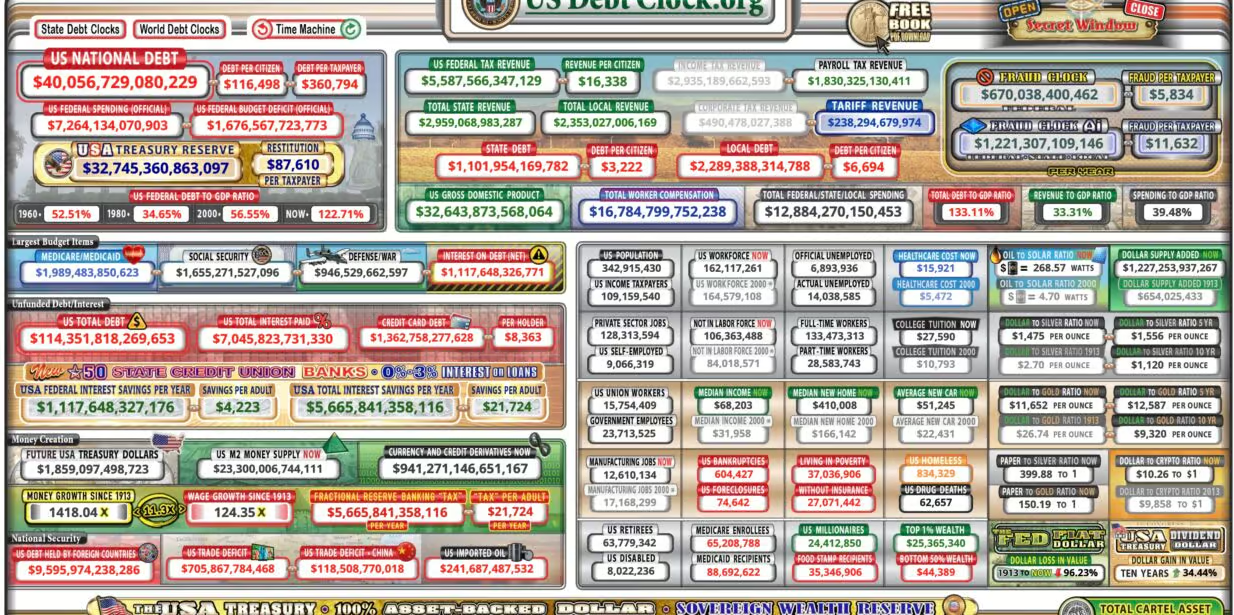
Kevin D. Freeman’s manifesto presents a stark assessment of the United States’ financial trajectory following the federal debt crossing the $40 trillion threshold in August 2026. Framing national debt as a security vulnerability rather than a mere ledger dispute, Freeman argues that unchecked government borrowing threatens sovereign stability, devalues the currency, and exposes the nation to foreign economic pressure. The text functions as both a critique of current fiscal policy and a blueprint for economic defense at both the state and household levels.
ADVERTISEMENT
The core of Freeman’s argument rests on the unprecedented velocity of recent national debt growth. The United States added $8 trillion in national debt over roughly three years – a rate of approximately $1 trillion every five months – without the context of a global conflict or economic shutdown.
The text breaks down the national debt structure into two primary categories:
· Publicly Held Debt: Approximately $32.2 trillion held by private investors, commercial banks, pension funds, and foreign governments. This portion requires continuous issuance and rollover through public Treasury auctions.
· Intergovernmental Holdings: Roughly $7.8 trillion held by internal federal accounts, representing obligations between different arms of the government.
Freeman emphasizes that the real-time ticker on USDebtClock.org highlights continuous, immediate borrowing that rapidly outpaces the official, delayed daily snapshots published by the U.S. Treasury.
ADVERTISEMENT
These are the major consequences of maintaining a $40 trillion public debt load:
1. Debt-to-GDP Ratio: At roughly 123%, the national debt exceeds total annual economic output. The text notes that the U.S. last reached these levels immediately after World War II, but unlike the post-1946 era, current government projections show the debt continuing to outpace economic expansion during peacetime.
2. Interest Outlays: Annual interest payments on the debt have grown to exceed national defense spending, becoming the second-largest item in the federal budget behind Social Security. Higher bond yields accelerate this dynamic as maturing debt refinances at elevated interest rates.
3. Refinancing Pressure: The 30-year Treasury yield surged past 5.3% in August 2026 – its highest benchmark since 2007 – forcing the U.S. Treasury to roll over maturing debt at significantly higher interest rates.
4. Fiscal Timelines: The statutory debt ceiling limit stands at $41.1 trillion, with projections from the Bipartisan Policy Center identifying a critical pressure window between late winter and mid-summer 2027.
5. Central Bank Gold Reserves: European Central Bank reports confirm gold surpassed U.S. Treasuries as the premier official global reserve asset, backed by central bank net purchases of 289 tonnes in Q2 2026.
6. Reserve Currency Outlook: According to the World Gold Council’s 2026 survey, 74% of central bankers anticipate a decline in the U.S. dollar’s total share of global reserves over the next five years.
ADVERTISEMENT
7. Individual Burden: Total federal debt translated directly to the household level equals $116,490 per individual citizen based on USDebtClock.org metrics captured on August 20, 2026.
8. Shift in Global Reserves: Citing European Central Bank and World Gold Council data, the text highlights that global central banks increasingly purchase gold over U.S. Treasuries to diversify official reserves. This subtle shift in foreign demand forces domestic institutions or the central bank to absorb a larger share of federal debt issuance.
Freeman connects these economic developments to a broader geopolitical model detailed in his book, The Four Horsemen of the American Apocalypse. He identifies four distinct adversarial pressures facing the nation:
· The Red Horse: Ideological and economic opposition from Communist China.
· The Green Horse: Extremist movements and regional instability in the Middle East.
· The Blue Horse: Global governance structures operating outside direct democratic accountability.
· The Yellow Horse: Internal policy errors, administrative inefficiencies, and political inertia.
To address the debt, Freeman evaluates four potential exits: default, higher inflation, massive tax increases, or accelerated economic growth. Rejecting the first three as destructive to wages, savings, and domestic stability, he advocates exclusively for growth driven by a six-point plan:
· Regulatory Reduction: Streamlining federal rules to reduce compliance costs for businesses.
· Tax Stability: Maintaining low, predictable tax structures to encourage capital investment.
· Energy Independence: Expanding domestic energy production to lower inputs across manufacturing and technology sectors.
· Spending Caps: Restricting federal expenditure growth below the rate of gross domestic product growth.
· Entitlement Reform: Addressing long-term structural deficits in Social Security and Medicare.
· Sound Money: Maintaining stable currency policy to protect purchasing power and wage growth.
Beyond national policy, the text provides actionable guidelines for individuals to mitigate personal financial risk during periods of high fiscal deficit and inflation:
· Debt Restructuring: Transition away from variable-rate liabilities to avoid rising interest charges.
· Hard Asset Allocation: Hold physical or tangible assets resilient to currency depreciation.
· Portfolio Stress Testing: Evaluate investment portfolios against scenarios involving higher long-term interest rates.
· Emergency Liquidity: Maintain sufficient short-term reserves to handle operational interruptions without liquidating long-term holdings.
· Financial Literacy: Ensure family members understand basic economic principles and personal liability ratios.
Freeman’s synthesis frames the $40 trillion threshold not as an inevitable endpoint, but as a critical decision point requiring structural reform at the government level and defensive strategy at the household level.
The Truth Must be Told
Your contribution supports independent journalism
Please take a moment to consider this. Now, more than ever, people are reading Geller Report for news they won't get anywhere else. But advertising revenues have all but disappeared. Google Adsense is the online advertising monopoly and they have banned us. Social media giants like Facebook and Twitter have blocked and shadow-banned our accounts. But we won't put up a paywall. Because never has the free world needed independent journalism more.
Everyone who reads our reporting knows the Geller Report covers the news the media won't. We cannot do our ground-breaking report without your support. We must continue to report on the global jihad and the left's war on freedom. Our readers’ contributions make that possible.
Geller Report's independent, investigative journalism takes a lot of time, money and hard work to produce. But we do it because we believe our work is critical in the fight for freedom and because it is your fight, too.
Please contribute here.

or
Make a monthly commitment to support The Geller Report – choose the option that suits you best.
ADVERTISEMENT
Quick note: We cannot do this without your support. Fact. Our work is made possible by you and only you. We receive no grants, government handouts, or major funding.Tech giants are shutting us down. You know this. Twitter, LinkedIn, Google Adsense, Pinterest permanently banned us. Facebook, Google search et al have shadow-banned, suspended and deleted us from your news feeds. They are disappearing us. But we are here.
Subscribe to Geller Report newsletter here— it’s free and it’s essential NOW when informed decision making and opinion is essential to America's survival. Share our posts on your social channels and with your email contacts. Fight the great fight.
Follow Pamela Geller on Gettr. I am there. click here.
Follow Pamela Geller on Trump's social media platform, Truth Social. It's open and free.
Remember, YOU make the work possible. If you can, please contribute to Geller Report.
Join The Conversation. Leave a Comment.
We have no tolerance for comments containing violence, racism, profanity, vulgarity, doxing, or discourteous behavior. If a comment is spammy or unhelpful, click the ... symbol to the right of the comment to let us know. Thank you for partnering with us to maintain fruitful conversation.






recent Comments