[ June 5, 2026 ]
The world’s leading state sponsor of terrorism should never have been allowed another day in power—and certainly not another opportunity to pull garbage like this. Every extra day this regime remains standing comes at the expense of freedom, stability, and human life. They forfeited any right to exist through decades of terror, oppression, and bloodshed.
A nuclear deal between these two evil besieged allies wreaks of desperation.
Iran, Russia Sign $25 Billion Nuclear Cooperation Deal as Tehran Presses Ahead Amid US Talks
avatarADVERTISEMENTBy Ailin Vilches Arguello, Algemeiner, June 5, 2026:
Iran and Russia have signed a sweeping $25 billion nuclear cooperation agreement to expand Tehran’s civilian nuclear infrastructure, deepening strategic ties between the two countries even as negotiations with the United States continue over efforts to curb the Islamist regime’s nuclear activities.
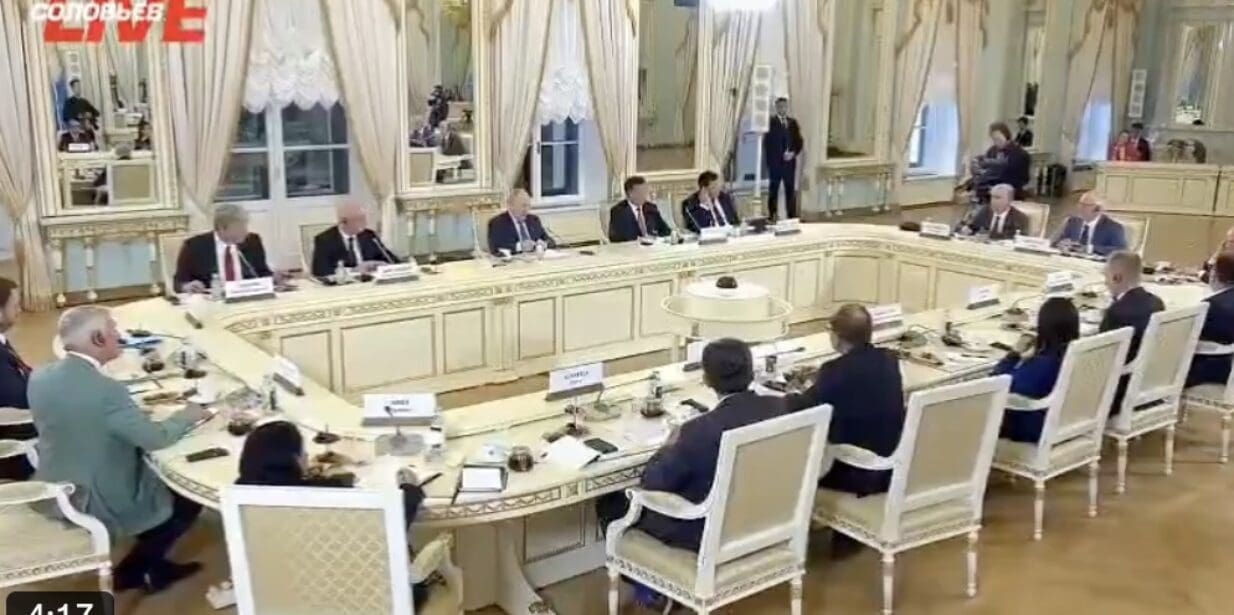
Speaking at a conference attended by senior officials and nuclear experts from both countries in the Russian capital, Iran’s ambassador to Russia, Kazem Jalali, unveiled what he described as the most extensive nuclear cooperation project ever launched between Tehran and Moscow, centered on the development of the Hormoz Nuclear Power Plant.
With the signing of a $25 billion memorandum of understanding, Jalali said the Hormoz project — alongside the ongoing expansion of the Bushehr Nuclear Power Plant — represents one of the most significant pillars of Iranian-Russian cooperation in the field of what Tehran describes as “peaceful nuclear energy.”
The Hormoz project is set to be developed by Iran’s “private sector” in cooperation with Russia’s state nuclear energy corporation, Rosatom, according to Iranian media.
ADVERTISEMENTThe memorandum also includes the expansion of the Bushehr Nuclear Power Plant — Iran’s only operational nuclear power station, which is currently generating electricity — with its second and third reactor units already under construction.
During the conference, Jalali also highlighted plans for joint cooperation on small-scale nuclear power plants, expressing optimism that the projects would soon move from the planning stage into full implementation.
The Iranian diplomat further underscored the growing scientific and technological partnership between Tehran and Moscow in the nuclear sector, particularly in the production of radiopharmaceuticals, which are used in nuclear medicine for diagnosis and cancer treatment.
“Iran has made remarkable progress in this field,” Jalali said. “We now produce 70 radiopharmaceutical products. In 2025, Iran ranked among the world’s top three producers of radiopharmaceuticals – demonstrating that our use of nuclear technology is strictly for peaceful purposes.”
In recent weeks, regional tensions have intensified as negotiations between US and Iranian officials have failed to produce a breakthrough, even as US President Donald Trump repeatedly insists that he still believes a strong agreement can be reached that prevents Tehran from obtaining a nuclear weapon.
While Iran has long denied plans to develop nuclear bombs, Western countries have argued weaponization is the only reason for much of Iran’s nuclear activity, including building secret sites into mountains and enriching uranium well beyond what’s needed for civilian use.
For its part, Iran is now pushing for an interim agreement that could potentially include sanctions relief, thus granting the regime access to billions of dollars in oil revenue. However, Washington has continued to impose economic sanctions on Iranian entities even as talks have taken place.
ADVERTISEMENTAccording to multiple media reports, Iran is seeking a limited interim agreement to ease mounting economic pressure and respond to rising domestic risks driven by a deepening economic crisis, while steering clear of any major concessions on its nuclear program.
Tehran’s latest diplomatic maneuvering follows weeks of negotiations after US-Israeli strikes in late February spiraled into a broader regional conflict. Iranian attacks across the Gulf have heightened fears over the security of the Strait of Hormuz, a chokepoint for roughly a fifth of global oil and liquefied natural gas supplies.
Three months later, despite a fragile ceasefire reached in early April, the conflict has settled into a tense stalemate, with a US blockade on Iranian ports and Tehran’s continued leverage over the Strait of Hormuz sustaining pressure on both sides while leaving the threat of renewed fighting unresolved.
Now, both Washington and Tehran appear to be lowering expectations for a comprehensive settlement, instead exploring what officials have described as a temporary memorandum of understanding — effectively an interim arrangement designed to prevent a return to open conflict while postponing core disputes surrounding Iran’s nuclear activities.
If finalized, a potential framework would reportedly focus on phased sanctions easing and limited access through the strait while leaving unresolved the most contentious issues, including Iran’s uranium enrichment capacity and its stockpile of highly enriched uranium.
It remains unclear whether Iran’s ambitious nuclear projects with Russia have been discussed with US negotiators.
The Truth Must be Told
Your contribution supports independent journalism
Please take a moment to consider this. Now, more than ever, people are reading Geller Report for news they won't get anywhere else. But advertising revenues have all but disappeared. Google Adsense is the online advertising monopoly and they have banned us. Social media giants like Facebook and Twitter have blocked and shadow-banned our accounts. But we won't put up a paywall. Because never has the free world needed independent journalism more.
Everyone who reads our reporting knows the Geller Report covers the news the media won't. We cannot do our ground-breaking report without your support. We must continue to report on the global jihad and the left's war on freedom. Our readers’ contributions make that possible.
Geller Report's independent, investigative journalism takes a lot of time, money and hard work to produce. But we do it because we believe our work is critical in the fight for freedom and because it is your fight, too.
Please contribute here.

or
Make a monthly commitment to support The Geller Report – choose the option that suits you best.
ADVERTISEMENTQuick note: We cannot do this without your support. Fact. Our work is made possible by you and only you. We receive no grants, government handouts, or major funding.Subscribe to Geller Report newsletter here— it’s free and it’s essential NOW when informed decision making and opinion is essential to America's survival. Share our posts on your social channels and with your email contacts. Fight the great fight.
Follow Pamela Geller on Gettr. I am there. click here.
Follow Pamela Geller on Trump's social media platform, Truth Social. It's open and free.
Remember, YOU make the work possible. If you can, please contribute to Geller Report.
Join The Conversation. Leave a Comment.
We have no tolerance for comments containing violence, racism, profanity, vulgarity, doxing, or discourteous behavior. If a comment is spammy or unhelpful, click the ... symbol to the right of the comment to let us know. Thank you for partnering with us to maintain fruitful conversation.