[ June 17, 2026 ]
The president continues to press on the deal with Iran from the G7 meeting in Evian-les-Bains, France. The formal signing is reportedly expected to occur this Friday (June 19) in Switzerland.
Included in memorandum: “an immediate and permanent end to the war on all fronts, including Lebanon” and “upon the signing of this Memorandum of Understanding, the United States Lift the naval blockade and prevent any interference or obstruction against the Islamic Republic of Iran.” Regarding nuclear, “The Islamic Republic of Iran reiterates that it will never produce nuclear weapons. The Islamic Republic of Iran and the United States have agreed that the fate of enriched material and the fate of all other mutually agreed nuclear-related issues, including Iran’s nuclear needs, will be adequately addressed in a final agreement.” And, regarding Iranian assets, frozen or restricted funds and assets of the Islamic Republic of Iran will be released and made fully available” (Bloomberg).
Iranians ‘Shocked’ That the Americans Made This Bad Deal
ADVERTISEMENT
NEW: Bloomberg publishes text of the draft MoU between the U.S. and Iran pic.twitter.com/FXhw57jMKV
— Insider Paper (@TheInsiderPaper) June 17, 2026
- The US and Iran are expected to sign a memorandum of understanding, paving the way for talks aimed at ending their war and putting new limits on Iran’s nuclear program.
- The memorandum outlines a 60-day period for negotiations, during which the US will lift its naval blockade and Iran will resume the movement of merchant ships.
- The agreement includes provisions for the US to end sanctions against Iran, provide financing for Iran’s economic development, and establish a mechanism to oversee the implementation of the final agreement.
The US and Iran are expected to formally sign a memorandum of understanding on June 19 in Switzerland, paving the way for 60 days of talks aimed at ending their war for good and putting strict new limits on Iran’s nuclear program.
If authentic, these would be the most politically explosive and and I’ve outline the controversial provisions but first here is the White House’s response to the critics:
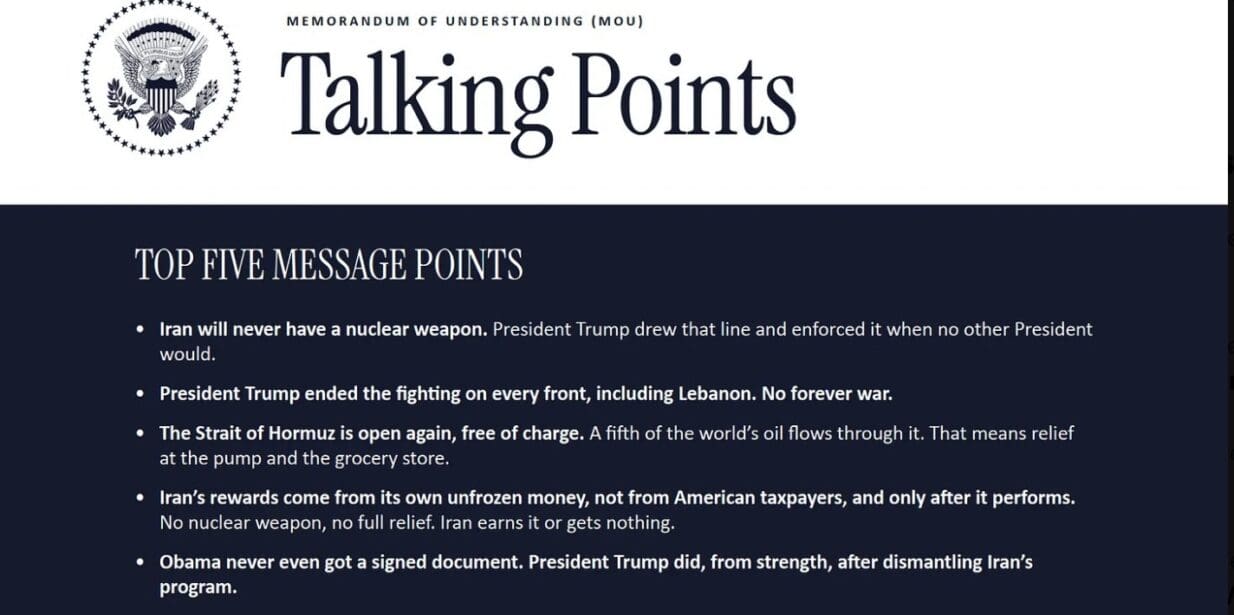
Here is the full PDF of White House talking points circulated on the MOU. You can glean much of what's in the doc based on how they're selling it and on what Vance and Kushner said in a call with journalists yesterday. Note that the "small gestures" Kushner alluded to were likely… pic.twitter.com/TZLDtAxSY0
— Michael Weiss (@michaeldweiss) June 16, 2026
The White House talking points fundamentally change how supporters of the deal will frame it.
ADVERTISEMENTWhite House’s Core Argument
The administration is not selling this as:
- “We gave Iran sanctions relief.”
They are selling it as:
- Trump destroyed Iran’s nuclear program first.
- Iran came to the table from weakness.
- Iran gets benefits only after compliance.
- Frozen assets are Iran’s own money, not U.S. taxpayer money.
- Gulf allies support the agreement.
- The deal ends the Lebanon front and opens the Strait of Hormuz.
- The agreement is signed and backed by a future U.N. resolution.
- This is “peace through strength,” not Obama’s JCPOA.
The Biggest Vulnerabilities Critics Will Attack
Even accepting the White House framing, these remain the most controversial points:
1. $300 Billion for Iran
The talking points try to soften this by saying:
“funded with regional partners, not American taxpayers.”
But critics will ask:
- Which regional partners?
- Saudi Arabia?
- UAE?
- Qatar?
And more importantly:
ADVERTISEMENT
- Why should the Iranian regime receive a $300 billion economic rehabilitation package at all?
This will likely be the most politically explosive provision.
2. Full Sanctions Relief
The White House says:
“No performance, no payoff.”
However the MOU explicitly commits the U.S. to ending sanctions as part of the final agreement.
Critics will argue:
- Iran has repeatedly violated previous agreements.
- Sanctions are America’s primary leverage.
- Once removed, reimposing them becomes politically difficult.
3. Release of Frozen Assets
The White House’s answer is:
“It’s Iran’s own money.”
Opponents will counter:
- Money is fungible.
- Every dollar released frees up other regime funds.
- Those resources can support proxies, missile programs, or repression.
4. Iran’s Nuclear Infrastructure
The White House claims:
“Iran’s nuclear program is in ruins.”
Yet the actual MOU language does not appear to require immediate dismantlement of enrichment capability.
The key phrase is:
“the fate of enriched material” will be addressed later.
That leaves room for criticism.
5. Lebanon Language
The White House treats this as a huge win:
“The MOU ends the fighting, including in Lebanon.”
Critics will ask:
- What happens to Hezbollah’s arsenal?
- What happens to Iran’s support for Hezbollah?
- What enforcement exists if attacks resume?
The Strongest White House Selling Point
The argument that will probably resonate most with Trump supporters is this one:
Obama negotiated before destroying Iran’s nuclear infrastructure. Trump negotiated after destroying it.
The entire document is built around that contrast.
The Most Damaging Question Critics Can Raise
If I were looking at this purely as a political document, the hardest question for the administration is:
If Iran’s nuclear program has been shattered, its economy is collapsing, and the regime has been brought to its knees, why does it need $300 billion in development financing, sanctions relief, unrestricted oil exports, and access to frozen assets to sign a final agreement?
That is the tension running through the entire debate. The White House’s answer is “performance-based peace.” Critics’ answer will be “rewarding the regime after victory was already achieved.
1. Iran Keeps Its Nuclear Program Intact During Negotiations
- Iran only promises it “will never produce nuclear weapons.”
- The draft does not require immediate dismantlement of enrichment facilities.
- It says Iran will maintain the “status quo” on its nuclear program during talks.
- The fate of enriched uranium is deferred to a future agreement.
Why controversial: Critics would argue Iran is being allowed to retain its nuclear infrastructure while receiving concessions upfront.
2. Massive Sanctions Relief
- The U.S. would commit to ending:
- UN sanctions
- IAEA-related restrictions
- Primary U.S. sanctions
- Secondary sanctions
Why controversial: This would effectively dismantle much of the international pressure architecture built over decades.
3. Release of Frozen Iranian Assets
- “Frozen or restricted funds and assets” would be released and made “fully available.”
- Iran’s central bank would determine final use.
Why controversial: Opponents would argue billions could flow to a regime that continues supporting proxy groups and regional militias.
4. U.S. Oil Waivers Immediately
- Treasury would authorize exports of:
- Iranian crude oil
- Petrochemicals
- Banking services
- Insurance
- Shipping
Why controversial: Iran begins earning substantial revenue before a final nuclear agreement is reached.
5. $300 Billion Economic Development Package
- U.S. and regional partners would create a plan for Iran’s rehabilitation and development.
- Minimum financing: $300 billion.
Why controversial: This is likely the single most shocking provision politically. Critics would portray it as a massive bailout of the Iranian regime.
6. End of Naval Blockade / Maritime Restrictions
- U.S. would lift naval restrictions immediately.
- Maritime traffic restored to pre-war levels.
Why controversial: Seen by critics as relinquishing leverage before Iran makes irreversible concessions.
7. U.S. Military Withdrawal
- U.S. forces would withdraw from surrounding areas within 30 days after a final agreement.
Why controversial: Opponents would argue it weakens deterrence and expands Iranian influence.
8. “Permanent End to the War on All Fronts”
- Includes Lebanon.
- Both sides pledge no hostile action.
Why controversial: Critics may argue it effectively freezes conflict without addressing Iranian proxy forces such as Hezbollah.
9. No New U.S. Sanctions During Talks
- U.S. agrees not to impose new sanctions.
- U.S. agrees not to strengthen regional military deployments.
Why controversial: Iran receives assurances while negotiations remain unresolved.
10. Binding U.N. Security Council Resolution
- Final agreement would be embedded in a binding U.N. resolution.
Why controversial: Future U.S. administrations could find it more difficult to reverse.
The MOU published by Bloomberg:
The Headline Provision
The provision likely to generate the strongest political backlash is:
The United States and its partners would provide at least $300 billion for Iran’s economic development while simultaneously lifting sanctions, releasing frozen assets, allowing oil exports, and leaving final decisions on enriched uranium for later negotiations.
That combination—money, sanctions relief, asset releases, and delayed nuclear concessions—would almost certainly become the central point of controversy.
Below is the text of the 14-point draft memorandum, as seen by Bloomberg News.
Iran’s Tasnim news agency cited an unnamed official on Wednesday as saying parts of the text published by Bloomberg are inaccurate. The report did not specify what was different. Bloomberg previously reported that there could be differences in the wording between the English and Persian versions of the MOU.
- The Islamic Republic of Iran and the United States, together with their allies in the current war, declare upon the signing of this Memorandum of Understanding an immediate and permanent end to the war on all fronts, including Lebanon, and undertake that from now on they will not launch any hostile action against each other, and will refrain from the threat or use of force against each other. The final agreement will confirm the provisions of this Article and the remaining Articles.
- The Islamic Republic of Iran and the United States undertake to respect each other’s sovereignty and territorial integrity, and to refrain from interfering in each other’s internal affairs.
- The Islamic Republic of Iran and the United States undertake to negotiate and reach a final agreement within a maximum period of 60 days, extendable by mutual consent.
- Immediately upon the signing of this Memorandum of Understanding, the United States Lift the naval blockade and prevent any interference or obstruction against the Islamic Republic of Iran, and restore traffic within a maximum of 30 days to its full capacity; the traffic of ships shall be proportional to the pre-war volume of traffic on the part of the Islamic Republic of Iran. The United States also undertakes to withdraw its forces from the surrounding areas within 30 days after the final agreement.
- Upon signing this Memorandum of Understanding, the Islamic Republic of Iran will immediately take steps to ensure that the movement of merchant ships from the Persian Gulf to the Sea of Oman and vice versa is resumed within 30 days to the pre-war volume, taking into account the need for the removal of technical obstacles and the neutralization of mines by Iran.
- The United States undertakes, together with its regional partners, to create a comprehensive plan agreed upon by both parties for the rehabilitation and economic development of the Islamic Republic of Iran, While ensuring financing of at least $300 billion. The implementation mechanism of this plan, as part of the final agreement, will be formulated within 60 days.
- The United States commits to ending, on a schedule to be agreed upon as part of the final agreement, all types of sanctions currently facing the Islamic Republic of Iran, including resolutions of the United Nations Security Council and the Board of Governors of the International Atomic Energy Agency (IAEA), and all unilateral U.S. sanctions, both primary and secondary.
- The Islamic Republic of Iran reiterates that it will never produce nuclear weapons. The Islamic Republic of Iran and the United States have agreed that the fate of enriched material and the fate of all other mutually agreed nuclear-related issues, including Iran’s nuclear needs, will be adequately addressed in a final agreement; the final agreement will confirm the provisions of this Article.
- The Islamic Republic of Iran and the United States agree that, pending a final agreement, they will maintain the status quo: Iran will maintain the status quo on its nuclear program, and the United States will not impose new sanctions on Iran or strengthen its forces in the region.
- The United States undertakes that immediately after the signing of this Memorandum of Understanding, and until the date of the lifting of sanctions, the United States Treasury Department will issue waivers for exports of Iranian crude oil, petrochemical products and their derivatives, and all related services, including banking, insurance, transportation, and the like.
- The United States undertakes that, in light of the progress of negotiations towards a final agreement, frozen or restricted funds and assets of the Islamic Republic of Iran will be released and made fully available. These funds, whether held in the master account or transferred, will be used for any final beneficiary payment determined by the Central Bank of the Islamic Republic of Iran and will be fully available for use. The United States undertakes to issue all necessary permits and licenses on this basis.
- The Islamic Republic of Iran and the United States agree that an implementation mechanism will be established to oversee the successful implementation of and future commitment to the Final Agreement.
- Following the signing of this Memorandum of Understanding, and upon receipt of assurances regarding the commencement of implementation of Articles 4, 5, 10, and 11 of this Memorandum of Understanding, and the continued implementation of these steps, the Islamic Republic of Iran and the United States will enter into negotiations for a Final Agreement solely with respect to the remaining Articles.
- The final agreement will be approved through a binding resolution of the UN Security Council.
The Truth Must be Told
Your contribution supports independent journalism
Please take a moment to consider this. Now, more than ever, people are reading Geller Report for news they won't get anywhere else. But advertising revenues have all but disappeared. Google Adsense is the online advertising monopoly and they have banned us. Social media giants like Facebook and Twitter have blocked and shadow-banned our accounts. But we won't put up a paywall. Because never has the free world needed independent journalism more.
Everyone who reads our reporting knows the Geller Report covers the news the media won't. We cannot do our ground-breaking report without your support. We must continue to report on the global jihad and the left's war on freedom. Our readers’ contributions make that possible.
Geller Report's independent, investigative journalism takes a lot of time, money and hard work to produce. But we do it because we believe our work is critical in the fight for freedom and because it is your fight, too.
Please contribute here.

or
Make a monthly commitment to support The Geller Report – choose the option that suits you best.
ADVERTISEMENT
Quick note: We cannot do this without your support. Fact. Our work is made possible by you and only you. We receive no grants, government handouts, or major funding.Tech giants are shutting us down. You know this. Twitter, LinkedIn, Google Adsense, Pinterest permanently banned us. Facebook, Google search et al have shadow-banned, suspended and deleted us from your news feeds. They are disappearing us. But we are here.
Subscribe to Geller Report newsletter here— it’s free and it’s essential NOW when informed decision making and opinion is essential to America's survival. Share our posts on your social channels and with your email contacts. Fight the great fight.
Follow Pamela Geller on Gettr. I am there. click here.
Follow Pamela Geller on Trump's social media platform, Truth Social. It's open and free.
Remember, YOU make the work possible. If you can, please contribute to Geller Report.
Join The Conversation. Leave a Comment.
We have no tolerance for comments containing violence, racism, profanity, vulgarity, doxing, or discourteous behavior. If a comment is spammy or unhelpful, click the ... symbol to the right of the comment to let us know. Thank you for partnering with us to maintain fruitful conversation.