[ April 14, 2026 ]
The Sacred Corridor and the Ancient Flame are what keep the Hormuz Open for India
By: Amil Imani
The year 2026 has turned the world’s most vital waterway into a silent, jagged canyon of steel and shadow. As the Strait of Hormuz constricts under the weight of modern war, the flags of a dozen nations have vanished from its surface. Yet, through the sulfurous haze of the Gulf, the Indian tricolor still moves – not as an intruder, but as a guest in a familiar house.
ADVERTISEMENT
As of mid-March 2026, while nearly 500 tankers remain stranded and global oil prices carry a nearly $20 risk premium, India has successfully negotiated the exit of key energy carriers like the Shivalik, Nanda Devi, and Jag Laadki. The question echoing through global capitals is: Why does the Strait remain open for India when it is slammed shut for almost everyone else?
To truly understand why the Hormuz remains open for India, one must look past the oil barrels and the ballistic trajectories. One must look into the “Civilizational Trust” that predates the very concept of a border.
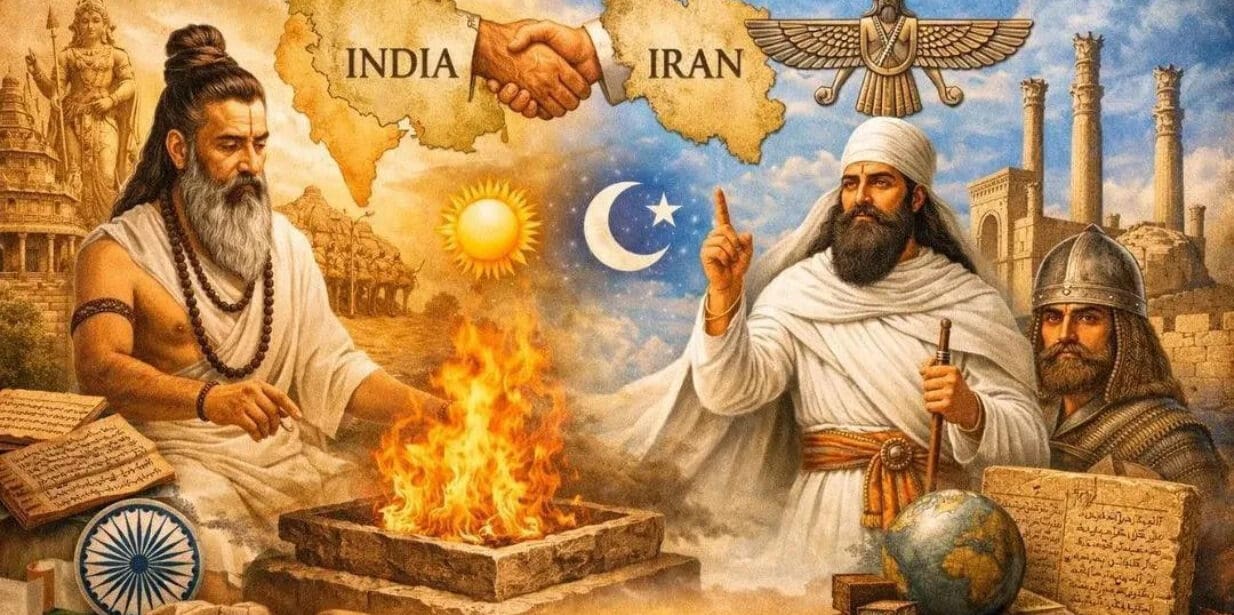
Before there was a New Delhi or a Tehran, there were two people who were one. In the dawn of time, the Indians called their home Aryavarta, while the Iranians spoke of Airyanem Vaejah. Both names were a vow of the “honorable,” a shared identity that has survived three millennia of shifting sands.
When an Indian tanker enters the Strait today, it sails through a linguistic mirror. The Sanskrit Sapta (seven) became the Avestan Hapta. The sacred Sindhu river of the Vedas flowed into the Persian tongue as the Hindu. Even the name Hindustan – the very identity of the subcontinent – is more Persian than Indian; this word is a gift of Persian recognition. More than a relationship of current leaders, it is a memory of the DNA.
The humanitarian window India enjoys in 2026 is guarded by the living presence of shared gods. While modern ideologies have swept the surface of the earth, the foundations remain unshaken. It is on this very foundation that the diplomatic capital, built over decades of cooperation on projects like the Chabahar Port, allows India to be viewed by Tehran not as an adversary, but as a “responsible stakeholder” and a historical friend.
ADVERTISEMENT
Speaking of history, in the Iranian province of Lorestan, a 3,200-year-old plaque of Ganesha sits in the dust, a silent witness to a time when there was no “us” and “them.” In Bandar Abbas, the murals of Krishna still adorn the walls of a Vishnu temple. Even the most radical of modern regimes could not dare to erase these paintings; to do so would be to erase the very roots of the Persian soul.
Perhaps the deepest reason the Hormuz stays open for India is a debt of 1,300 years. When the Sassanian Empire collapsed in 651 CE, and the Zoroastrian fire temples were being razed to the ground, the “Arya” of Persia looked toward the East.
They sailed across the Arabian Sea and knocked on India’s door. India did not ask for their gold or their conversion; she offered them the soil of Gujarat. Today, the Iranshah Atash Behram – the oldest living sacred fire of Zoroastrianism – burns not in Shiraz, but in Udvada. India saved the Persian civilization when Persia could not save itself. Every time an Indian ship passes through the Strait in 2026, it is a silent, poetic return to that sanctuary.
In the history of the world, neighbors are defined by their wars. Yet, between these two great civilizations, there has not been a single war for over 3,000 years. They never invaded each other. Instead, they traded wisdom. The father of Darius the Great studied under Brahmins in Bharat, taking that light back to the Magi. Taxila, the world’s first great university, flourished under the care of Persian administrators.
In the 2026 crisis, while Western navies deploy carriers and threats, India deploys Operation Sankalp. Its warships do not act as an occupational force but as a familiar presence. The Iranian authorities see the Indian flag and recognize a partner that has never sought their destruction.
This civilizational trust manifests in 2026 through a seamless bridge between ancient bonds and modern reality. The linguistic transition from Sapta-Sindhu to Hapta-Hindu has evolved into a contemporary diplomatic ease, where shared nuances allow for a dialogue that transcends standard geopolitics. The profound historical memory of the Parsi Migration in 785 CE continues to command a deep-seated respect from Iran, honoring India’s role as a sanctuary for their ancestral flame. This foundation is fortified by a staggering legacy of zero wars in 3,000 years, a record of peace that translates today into a high level of naval and tactical coordination. Ultimately, the intellectual heritage of Brahmins teaching the Magi survives in the modern era as a robust partnership, ensuring that projects like the INSTC and Chabahar remain vital veins of cooperation even amidst global turmoil.
The Strait of Hormuz remains open for India because trust is the only currency that does not devalue during a war. When a call goes from New Delhi to Tehran, it is much more than a ring in a government office; it rings in a shared history.
ADVERTISEMENT
Sanskrit may have been suppressed, and Taxila may be a ruin, but the connection was never truly lost. India passes through the Hormuz because she is the keeper of the flame, the sister of the Arya, and the only neighbor who never drew a sword. In the turbulence of 2026, the Strait is not just a maritime route for India – it is a homecoming.
The Truth Must be Told
Your contribution supports independent journalism
Please take a moment to consider this. Now, more than ever, people are reading Geller Report for news they won't get anywhere else. But advertising revenues have all but disappeared. Google Adsense is the online advertising monopoly and they have banned us. Social media giants like Facebook and Twitter have blocked and shadow-banned our accounts. But we won't put up a paywall. Because never has the free world needed independent journalism more.
Everyone who reads our reporting knows the Geller Report covers the news the media won't. We cannot do our ground-breaking report without your support. We must continue to report on the global jihad and the left's war on freedom. Our readers’ contributions make that possible.
Geller Report's independent, investigative journalism takes a lot of time, money and hard work to produce. But we do it because we believe our work is critical in the fight for freedom and because it is your fight, too.
Please contribute here.

or
Make a monthly commitment to support The Geller Report – choose the option that suits you best.
ADVERTISEMENT
Quick note: We cannot do this without your support. Fact. Our work is made possible by you and only you. We receive no grants, government handouts, or major funding.Tech giants are shutting us down. You know this. Twitter, LinkedIn, Google Adsense, Pinterest permanently banned us. Facebook, Google search et al have shadow-banned, suspended and deleted us from your news feeds. They are disappearing us. But we are here.
Subscribe to Geller Report newsletter here— it’s free and it’s essential NOW when informed decision making and opinion is essential to America's survival. Share our posts on your social channels and with your email contacts. Fight the great fight.
Follow Pamela Geller on Gettr. I am there. click here.
Follow Pamela Geller on Trump's social media platform, Truth Social. It's open and free.
Remember, YOU make the work possible. If you can, please contribute to Geller Report.
Join The Conversation. Leave a Comment.
We have no tolerance for comments containing violence, racism, profanity, vulgarity, doxing, or discourteous behavior. If a comment is spammy or unhelpful, click the ... symbol to the right of the comment to let us know. Thank you for partnering with us to maintain fruitful conversation.