“We must always take sides. Neutrality helps the oppressor, never the victim. Silence encourages the tormentor, never the tormented.” Elie Weisel
Have we learned nothing?
It is with great sadness that I report on the passing of Elie Weisel, the conscience, the witness, Nobel Laureate Holocaust survivor, American Romanian-born Jewish writer, professor, political activist.
If you haven’t read “Night” — do so now. His poignant memoir about surviving Nazi concentration camps is seared into my memory.
ADVERTISEMENT
Elie Wiesel, Nobel Laureate, Holocaust Survivor and ‘Night’ Author, Dies at 87, By Elizabeth Chuck, NBC News, July 2, 2016:
Elie Wiesel, the prolific Nobel Peace Prize laureate whose poignant memoir about surviving Nazi concentration camps became standard reading for children around the globe, has died. He was 87.
Wiesel’s son, Elisha Wiesel, told NBC News on Saturday that the author had died, and said the family is observing Shabbat and has requested privacy at the moment.
Wiesel, who was born in 1928 in Romania, was forced in May 1944 into Auschwitz, where he eventually watched his sick, malnourished father Shlomo Wiesel,die after getting beaten by a German soldier. He wrote about the experience, plus the deaths of his mother and younger sister during the Holocaust, in his acclaimed 1955 autobiography, “Night.”
Holocaust activist and Nobel Peace Prize recipient Elie Wiesel, 83, in his office on in New York on Sept. 12, 2012. Bebeto Matthews / AP
The atrocities he witnessed fueled Wiesel to combat inhumanity around the world, including in the former Yugoslavia and in Darfur — efforts that in 1986, earned him a Nobel Peace Prize.
ADVERTISEMENT
“We must speak, we must take sides, for neutrality helps the oppressor — never the victim,” he said upon receiving the prize.
The prize’s citation referred to him as “a messenger to mankind.”
Tributes for Wiesel immediately started pouring in Saturday, with Israeli Prime Minister Benjamin Netanyahu calling him a “beacon of light to the humanity of people who believed in the good of everyone.”
The World Jewish Congress President Ronald Lauder said in a statement that Wiesel “was more than a revered writer. He was also a teacher for many of us. He taught us about the horrors of Auschwitz. He taught us about Judaism, about Israel, and about not being silent in the face of injustice.”
Jerusalem Mayor Nir Barkat, who a few months ago gave Wiesel the medal of Honorary Citizen of Jerusalem, said of the author: “Instead of giving in to despair, the face of evil and cruelty that at the time was the darkest of humanity, he carried all the way through the message of tolerance and peace for all peoples of the world.”
Following the war, Wiesel was sent to a French orphanage, where he was reunited with his older sisters, Beatrice and Hilda. He first took up writing in his 20s, when he became a journalist for French and Israeli publications.
Despite later becoming a ubiquitous, first-hand account of surviving the Holocaust, “Night” sold under 2,000 copies in the United States in the first 18 months after it was published.
ADVERTISEMENT
It has now sold more than 6 million copies, according to Israeli newspaper Haaretz, which first reported Wiesel’s death.
Wiesel originally wrote “Night” in French and had it translated into English. The book enjoyed renewed popularity when Oprah Winfrey chose a new translation of “Night” by Wiesel’s wife, Austrian Holocaust survivor Marion Rose, for her book club in 2006.
Wiesel and Marian married in Jerusalem in 1969. She also translated his future books, including “Dawn” and “Day,” which completed his trilogy series on the Holocaust. In all, he wrote more than 50 works of fiction and nonfiction.
Wiesel met his wife in New York, where he had moved to in 1955. Over the years, he became a vocal activist, earning him the U.S. Presidential Medal of Freedom in addition to the Nobel Peace Prize for speaking out against discrimination and racism.
Wiesel became an outspoken advocate of education on the Holocaust when President Jimmy Carter appointed him chairman of the Presidential Commission on the Holocaust in 1978. In that role, he helped create the U.S. Holocaust Memorial Museum in Washington, D.C.
A quote from Wiesel — “for the dead and the living, we must bear witness — is displayed at the museum’s entrance.
Wiesel didn’t shy away from his past. In 2006, he went to Auschwitz with Winfrey, and in 2009, Wiesel went with President Barack Obama and German Chancellor Angela Merkel to a trip to the Buchenwald concentration camp.
His faith never wavered. At the Holocaust Days of Remembrance Ceremony in April 2009, standing alongside Obama in the Capitol Rotunda, Wiesel said, “I belong to a traumatized generation that felt abandoned by God and betrayed by mankind. And yet, I believe that one must not estrange from God or mankind.”
The Nobel Peace Prize laureate, author and human rights activist passed away on Saturday at 87.
1. It seemed as impossible to conceive of Auschwitz with God as to conceive of Auschwitz without God. Therefore, everything had to be reassessed because everything had changed. (The Nobel Peace Prize speech, 1986)
2. For us, forgetting was never an option. Remembering is a noble and necessary act.
Elie Wiesel, highlighted in red, and other inmates in Buchenwald camp, 1945.Private H. Miller, U.S. Defence Visual Information Center
3. Indifference, to me, is the epitome of evil. (Interview with U.S. media, 1986)
4. I swore never to be silent whenever and wherever human beings endure suffering and humiliation. We must always take sides. Neutrality helps the oppressor, never the victim. Silence encourages the tormentor, never the tormented. (The Nobel Peace Prize speech, 1986)
5. Waking among the dead, one wondered if one was still alive. And yet real despair only seized us later. Afterwards. As we emerged from the nightmare and began to search for meaning. (The Nobel Peace Prize speech, 1986)
6. No one is as capable of gratitude as one who has emerged from the kingdom of night. (The Nobel Peace Prize speech, 1986)
7. I rarely speak about God. To God yes. I protest against Him. I shout at Him. But open discourse about the qualities of God, about the problems that God imposes, theodicy, no. And yet He is there, in silence, in filigree. (Interview to the Paris Review, 1984)
8. The opposite of love is not hate, it’s indifference. The opposite of beauty is not ugliness, it’s indifference. The opposite of faith is not heresy, it’s indifference. And the opposite of life is not death, but indifference between life and death. (Interview with U.S. media, 1986)
9. No human race is superior; no religious faith is inferior. All collective judgments are wrong. Only racists make them. (Interview to Parade Magazine, 1992)
10. When a Jew visits Jerusalem for the first time, it is not the first time; it is a homecoming. (Interview to Israeli media, 2010)
read more: http://www.haaretz.com/israel-news/1.728537
Please take a moment to consider this. Now, more than ever, people are reading Geller Report for news they won't get anywhere else. But advertising revenues have all but disappeared. Google Adsense is the online advertising monopoly and they have banned us. Social media giants like Facebook and Twitter have blocked and shadow-banned our accounts. But we won't put up a paywall. Because never has the free world needed independent journalism more.
Everyone who reads our reporting knows the Geller Report covers the news the media won't. We cannot do our ground-breaking report without your support. We must continue to report on the global jihad and the left's war on freedom. Our readers’ contributions make that possible.
Geller Report's independent, investigative journalism takes a lot of time, money and hard work to produce. But we do it because we believe our work is critical in the fight for freedom and because it is your fight, too.
Quick note: We cannot do this without your support. Fact. Our work is made possible by you
and only you. We receive no grants, government handouts, or major funding.Tech giants are shutting us down. You know this. Twitter, LinkedIn, Google Adsense, Pinterest permanently
banned us. Facebook, Google search et al have shadow-banned, suspended and deleted us from your news feeds.
They are disappearing us. But we are here.
Subscribe to Geller Report newsletter here— it’s free and it’s essential NOW when informed decision making and opinion is essential to America's survival.
Share our posts on your social channels and with your email contacts. Fight the great fight.
Remember, YOU make the work possible. If you can, please contribute to Geller Report.
Join The Conversation. Leave a Comment.
We have no tolerance for comments containing violence, racism, profanity, vulgarity, doxing, or discourteous behavior. If a comment is spammy or unhelpful, click the ... symbol to the right of the comment to let us know. Thank you for partnering with us to maintain fruitful conversation.
It is the conflict of our age, yet no one dares talk about it. The true story of the Islamic Supremacist war on free speech as told by those on the front lines fighting for our First Amendment rights,
.
Pamela Geller tells her own story of how she became one of the world's foremost activists for the freedom of speech,
individual rights, and equality of rights for all. "It's my story, it's what happens when someone fights for freedom in America today,"
Geller explained.
Today Islamic supremacists are demanding more accommodation of Islamic principles
and practices than ever, and daily growing more aggressive in eroding our freedoms – with politically
correct public officials only too happy..
Popular conservative blogger Pamela Geller and New York Times bestselling author
Robert Spencer sound a wake-up call for Americans to stop the Obama administration from limiting our
hard-won...
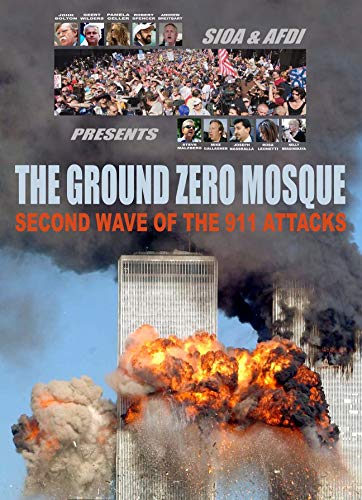
The Ground Zero Mosque: The Second Wave of the 9/11 Attacks is a groundbreaking documentary on the controversy
over the planned Islamic supremacist mega-mosque at Ground Zero.