
[ July 10, 2026 ]
Ali Khamenei ruled for thirty-seven years and built an empire on corpses. A US-Israeli airstrike ended his life on February 28, 2026 – and the blood-soaked machine he commanded didn’t blink.
Khamenei sat atop Iran’s government in the summer of 1988 while death committees executed thousands of political prisoners in a matter of weeks. Dissidents, students, and teenagers were marched to the gallows on the orders of tribunals that lasted minutes. Mass graves swallowed the evidence. The regime never apologized. It never will.
The 1988 massacre alone should have ended his career in shame. Prisoners already serving sentences – some near the end of their terms – were dragged back before four-man tribunals and asked a handful of questions about loyalty to the state. The wrong answer walked the prisoner straight to the gallows. Bodies were dumped in unmarked mass graves, many of which the regime still refuses to locate or acknowledge decades later. Families were never told where their sons and daughters were buried. Some are still searching.
ADVERTISEMENT
Fast forward to November 2019: Iranians rise up against a fuel price hike. Khamenei’s order to his commanders is blunt – crush it. Security forces gun down 1,500 civilians in the streets, children included, and the government cuts the entire national internet to blind the world to the slaughter.
Months later, in January 2020, the Revolutionary Guard shoots two missiles into a civilian passenger jet minutes after takeoff. One hundred seventy-six people – families, students, newlyweds – are erased. The regime lies for three days until leaked satellite data forces a confession.
By September 2022, the brutality hits a boiling point. Mahsa Amini, twenty-two years old, is beaten to death in custody for the crime of showing her hair. Her killing ignites the largest uprising the Islamic Republic has faced. The response from the top is bullets. The 2022 uprising spread to over a hundred cities in weeks. Schoolgirls tore down images of Khamenei in classrooms; women burned their headscarves in the street. The regime’s answer was mass arrest, torture in detention, and public executions carried out specifically to intimidate the movement into silence. Human rights monitors report the Revolutionary Guard killed thousands of protesters across these successive crackdowns – a toll the government works overtime to bury.
This is not a list of accusations. This is a ledger.
The machine runs on extortion and terror financing. Khamenei bankrolls Hamas. He arms Hezbollah. He funds the Houthis. He props up Assad, a dictator who gassed his own population and answered only to Tehran’s checkbook. Billions of dollars flow out of a country where ordinary Iranians face crushing inflation and shortages – the money diverted instead into proxy militias built to project the regime’s shadow across the region.
ADVERTISEMENT
Khamenei didn’t inherit this cartel; he built it, brick by brick, execution by execution. The Revolutionary Guard he commanded doesn’t function as a national army – it functions as a holding company for regional violence, with divisions dedicated to arming, training, and financing militias across five countries. Every dollar routed to Hezbollah’s rocket stockpiles or the Houthis’ drone program came from a treasury starved by sanctions and mismanagement, while ordinary Iranians watched their currency collapse. The math is brutal and simple: the regime spent on proxies what it refused to spend on its own people.
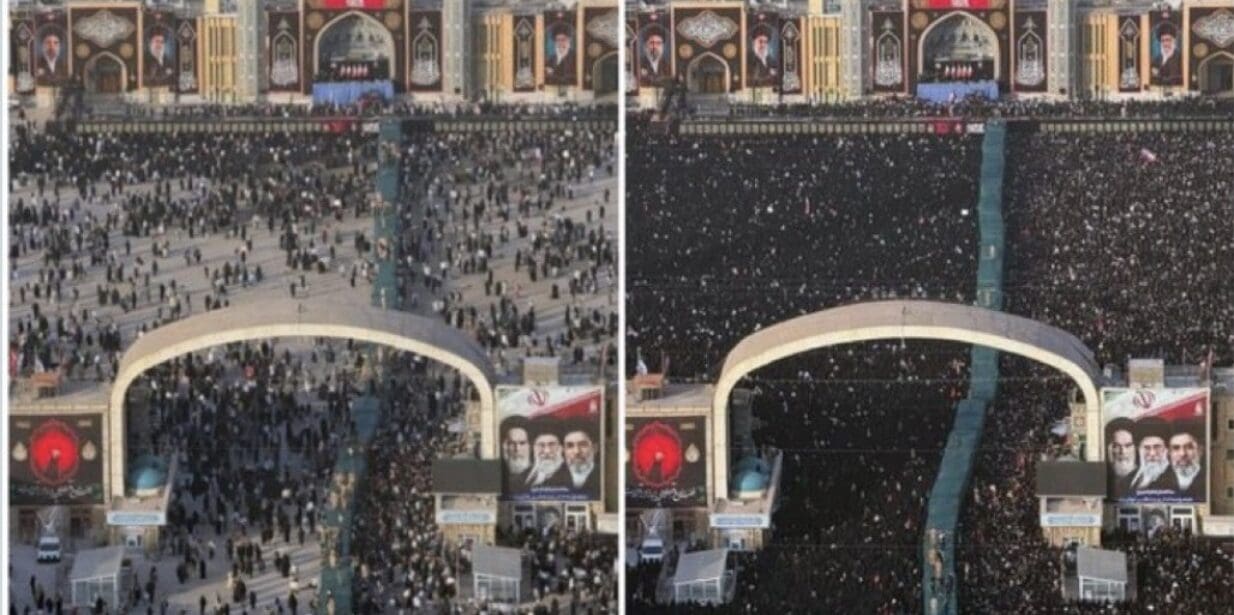
Iran staged a six-day state funeral this month – a tightly choreographed procession through Tehran, Qom, Najaf, Karbala, and Mashhad, backed by the full machinery of the state. Estimates place the actual turnout well under 100,000, heavily padded by 30,000 security personnel and foreign proxies bused in to fill the camera frames.
The physical stage management was supplemented by a parallel digital deception campaign. Regime supporters shared AI-generated videos of the Grand Mosalla Mosque and images of the Azadi Tower that contained glaring architectural errors, such as a beige dome instead of blue and non-existent trees. Not to be outdone, opposition groups distributed their own fake images, including one falsely showing dissident rapper Toomaj Salehi honoring Khamenei, which was flagged by AI detection tools for containing illegible, garbled text on the microphones. Verification tools like SynthID identified invisible watermarks on these images, confirming they were entirely produced by artificial intelligence rather than capturing real events on the ground.
Yet, Western media outlets like the New York Times, BBC, and CNN eagerly adopted the regime’s propaganda hook, line, and sinker, splashing headlines of millions mourning in the streets. This fixation exposes a pathological obsession within the Western cultural left. To relieve the burden of their own institutional guilt – viewing the West exclusively through the lens of capitalism and imperialism – these activists and journalists romanticize the Islamic Republic as a monument of resistance.
To maintain this ideological fantasy, they need the Iranian people to be primitive. They systematically erase Iran’s vibrant, highly educated, and deeply secular society, replacing it with a caricature of black-clad masses beating their chests. By validating the regime’s manufactured attendance sheets, the Western left performs a twisted moral baptism, using a flattened image of the noble savage to satisfy their own psychological neuroses.
But a funeral procession is not a referendum. Crowd size is not absolution. The same government orchestrating flag-draped coffins is the one that shut down the internet to hide a massacre and beat a woman to death for her hair. Grief on camera and terror in the interrogation room come from the same machine.
Khamenei’s death doesn’t end the ledger – it opens the chaotic question of who inherits it. His son Mojtaba, long rumored to be his chosen heir, is dead, leaving the dynastic succession shattered. Yet the Revolutionary Guard remains intact. The Basij remains armed. The proxy network still draws breath from Tehran’s treasury.
ADVERTISEMENT
The executioner is dead. The apparatus that made him possible – the death committees, the internet blackouts, the missile crews, the gallows – survives him entirely, waiting for its next commander.
History offers a clear warning: regimes built on fear rarely collapse the moment their figurehead dies. Stalin’s machine outlived Stalin; Assad’s machine outlived his father. The infrastructure of repression doesn’t need a charismatic leader to keep functioning. It needs only inertia and fear, and Iran’s apparatus has both in surplus.
What happens next matters more than what happened at the funeral. Whether a new loyalist faction consolidates power within the Revolutionary Guard, or the economic pressure of years of war finally cracks the loyalty of the security forces who’ve spent four decades pulling triggers on their own citizens, these are the questions that decide whether the ledger closes or simply gets a new signature at the bottom.
That is the story. Not a funeral. A cartel in transition.
The Truth Must be Told
Your contribution supports independent journalism
Please take a moment to consider this. Now, more than ever, people are reading Geller Report for news they won't get anywhere else. But advertising revenues have all but disappeared. Google Adsense is the online advertising monopoly and they have banned us. Social media giants like Facebook and Twitter have blocked and shadow-banned our accounts. But we won't put up a paywall. Because never has the free world needed independent journalism more.
Everyone who reads our reporting knows the Geller Report covers the news the media won't. We cannot do our ground-breaking report without your support. We must continue to report on the global jihad and the left's war on freedom. Our readers’ contributions make that possible.
Geller Report's independent, investigative journalism takes a lot of time, money and hard work to produce. But we do it because we believe our work is critical in the fight for freedom and because it is your fight, too.
Please contribute here.

or
Make a monthly commitment to support The Geller Report – choose the option that suits you best.
ADVERTISEMENT
Quick note: We cannot do this without your support. Fact. Our work is made possible by you and only you. We receive no grants, government handouts, or major funding.Tech giants are shutting us down. You know this. Twitter, LinkedIn, Google Adsense, Pinterest permanently banned us. Facebook, Google search et al have shadow-banned, suspended and deleted us from your news feeds. They are disappearing us. But we are here.
Subscribe to Geller Report newsletter here— it’s free and it’s essential NOW when informed decision making and opinion is essential to America's survival. Share our posts on your social channels and with your email contacts. Fight the great fight.
Follow Pamela Geller on Gettr. I am there. click here.
Follow Pamela Geller on Trump's social media platform, Truth Social. It's open and free.
Remember, YOU make the work possible. If you can, please contribute to Geller Report.
Join The Conversation. Leave a Comment.
We have no tolerance for comments containing violence, racism, profanity, vulgarity, doxing, or discourteous behavior. If a comment is spammy or unhelpful, click the ... symbol to the right of the comment to let us know. Thank you for partnering with us to maintain fruitful conversation.





recent Comments