
[ July 17, 2026 ]
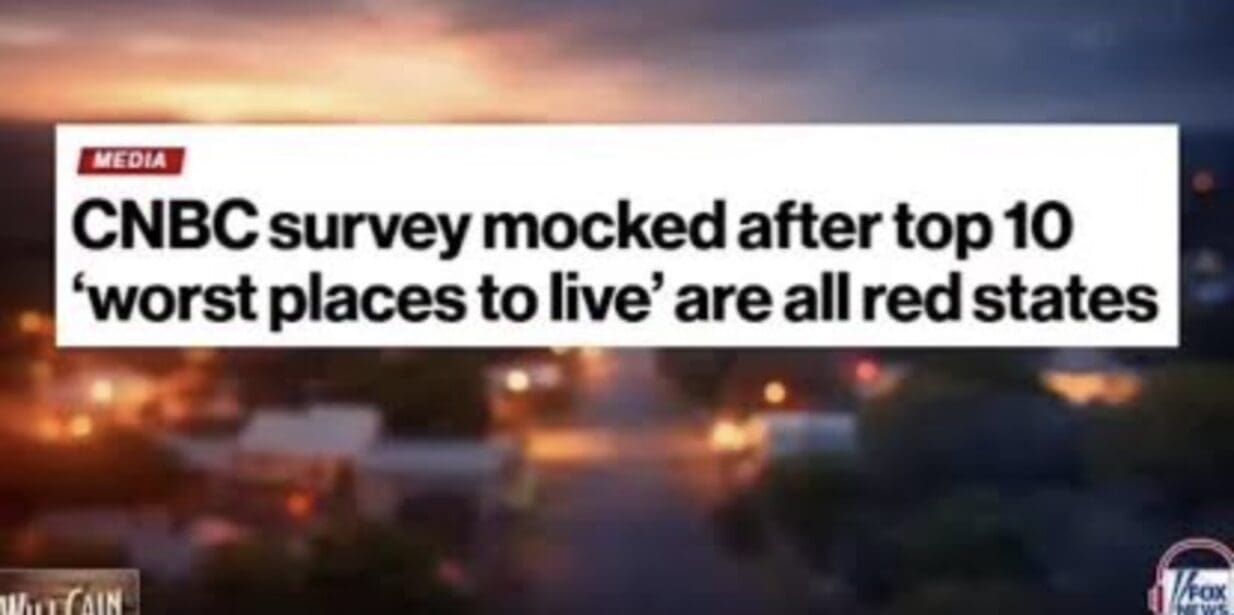
CNBC just ranked the top 10 worst states to live in. Shockingly (not), all of them are Red States because they have low taxes, pro second amendment policies, safe neighborhoods and a pro growth business environment.
10 worst:
1. Tennessee
2. Texas
3. Indiana
4. Louisiana
5. Georgia
6. Utah
7. Missouri
8. Alabama
9. Oklahoma
10.Arkansas
ADVERTISEMENT
10 worst states to live in for 2026, per CNBC:
1. Tennessee
2. Texas
3. Indiana
4. Louisiana
5. Georgia
6. Utah
7. Missouri
8. Alabama
9. Oklahoma
10.Arkansas— Leading Report (@LeadingReport) July 12, 2026
CNBC: ‘Best States To Live In’ Mutilate Kids, Free Criminals, Take All Your Money
By: Chuck DeVore, The Federalist, July 17, 2026
The headline on CNBC’s shiny new 2026 list screams, “Best States to Live In,” complete with glossy profiles of high-“inclusiveness” northern enclaves. Don’t be fooled. This isn’t an objective guide for families seeking opportunity and security. It’s the “Quality-of-Life-according-to-leftists” sliver of CNBC’s business competitiveness study. It’s propaganda repackaged as gospel for where Americans should want to raise kids and build lives.
The methodology reveals the game. CNBC touts “hard data” on crime, air quality, health-care access, and childcare costs. Fair enough on the raw numbers. But the “evidence” is layered in heavy subjective scoring for “inclusiveness of state laws,” worker protections (such as paid-leave mandates and laws favoring labor unions), and the ability to kill the unborn without restrictions. Not to mention they are sourced from outlets including Guttmacher and Oxfam which wear their leftist priors on their sleeves.
ADVERTISEMENTIn contrast, states resisting expansive abortion frameworks and diversity, equity, and inclusion (DEI) policies get docked. The result? A neat political map: Vermont, New Jersey, Maine, Minnesota, and company at the top; Tennessee, Texas, Indiana, Louisiana, and red-leaning Southern states scraping the bottom.
This isn’t neutral analysis. It’s a preference ranking for one vision of society — more mandates, more government levers on social issues, more alignment with coastal elite values. It directly echoes the European social model that delivers security for insiders today at the cost of compounded stagnation tomorrow.
CNBC’s “inclusiveness” rankings penalize policies that some 75 percent of Americans support. Such policies protect minors from gender mutilation and sterilize them for life. The ranking also gives demerits to states that restrict abortions for minors without parental consent, while giving thumbs up for discriminating against Christian adoptive parents. These are out of step with revealed preferences on culture, governance, opportunity, and actual migration.
Overseas patterns reveal the policy differences in stark terms. France and the United Kingdom, with their heavier worker protections, higher taxes, and regulatory thickets, have limped along with anemic growth for years. Poland, embracing more market-oriented reforms after communism and European Union accession in 1991, rocketed from roughly half the EU average gross domestic product per capita to around 80 percent today. After developing a more-capitalist model, it became a trillion-dollar economy with stronger growth, attracting investment and delivering rising living standards.
The bottom-line lesson: Small differences in annual growth compound into massive gaps in wages, innovation, pensions, and national vitality over decades. European-like “protections” lead to economic sclerosis. The leftists who complain most about “unaffordability” are the very ones driving unaffordability with socialist policies. They then keep the unaffordability cycle going by enacting social-welfare policies to deal with the failures of previous social-welfare policies. The same pattern repeats here in the United States. CNBC’s “best” states for living often feature slower job growth, higher costs, and net domestic out-migration. Texas alone added tens of thousands of net domestic migrants in recent periods while posting blockbuster absolute job gains. Florida, the Carolinas, Tennessee — CNBC’s doghouse — keep winning the real-world contest.
Americans aren’t fleeing to Vermont en masse. They’re heading where housing is more attainable, jobs are plentiful, taxes are lower, and governments prioritize results over DEI virtue signaling.
This isn’t new. CNBC does this trick every year: blue states crowned “best,” red Sun Belt states labeled deficient — while in real life, Americans flood into Texas, Florida, South Carolina, and Tennessee while fleeing Massachusetts, Colorado, and Washington. The 2026 list repeated the error with updated numbers but the same bias.
ADVERTISEMENTCrime metrics ignore well-documented demographic realities (such as FBI data on violent offending patterns). “Inclusiveness” rewards policies that many parents reject, such as bypassing consent on explicit instructional material for minors. Health and childcare stats get filtered through a lens that downplays family structure and culture.
True livability isn’t a United Health Foundation survey or Guttmacher score. It’s where families can afford a home, kids can grow up safe, parents can find work without endless mandates, and communities reflect shared values rather than top-down social engineering. Migration data, business expansion, family formation rates, and long-run income growth tell the story CNBC’s fantasy index obscures.
Red state governance wins because it delivers consistent standard of living improvement that matters for the next generation—not the static “protections” that trade dynamism for a false comfort.
CNBC will no doubt keep polishing its leftist wish list and then slapping the “best states to live” label on it. Meanwhile, Americans will keep seeking opportunity elsewhere. The feet don’t lie, even if the rankings do.
Chuck DeVore is chief national initiatives officer at the Texas Public Policy Foundation, a former California legislator, and a retired U.S. Army lieutenant colonel. He’s the author of “The Crisis of the House Never United—A Novel of Early America.”
The Truth Must be Told
Your contribution supports independent journalism
Please take a moment to consider this. Now, more than ever, people are reading Geller Report for news they won't get anywhere else. But advertising revenues have all but disappeared. Google Adsense is the online advertising monopoly and they have banned us. Social media giants like Facebook and Twitter have blocked and shadow-banned our accounts. But we won't put up a paywall. Because never has the free world needed independent journalism more.
Everyone who reads our reporting knows the Geller Report covers the news the media won't. We cannot do our ground-breaking report without your support. We must continue to report on the global jihad and the left's war on freedom. Our readers’ contributions make that possible.
Geller Report's independent, investigative journalism takes a lot of time, money and hard work to produce. But we do it because we believe our work is critical in the fight for freedom and because it is your fight, too.
Please contribute here.

or
Make a monthly commitment to support The Geller Report – choose the option that suits you best.
ADVERTISEMENTQuick note: We cannot do this without your support. Fact. Our work is made possible by you and only you. We receive no grants, government handouts, or major funding.Subscribe to Geller Report newsletter here— it’s free and it’s essential NOW when informed decision making and opinion is essential to America's survival. Share our posts on your social channels and with your email contacts. Fight the great fight.
Follow Pamela Geller on Gettr. I am there. click here.
Follow Pamela Geller on Trump's social media platform, Truth Social. It's open and free.
Remember, YOU make the work possible. If you can, please contribute to Geller Report.
Join The Conversation. Leave a Comment.
We have no tolerance for comments containing violence, racism, profanity, vulgarity, doxing, or discourteous behavior. If a comment is spammy or unhelpful, click the ... symbol to the right of the comment to let us know. Thank you for partnering with us to maintain fruitful conversation.