
[ June 1, 2026 ]
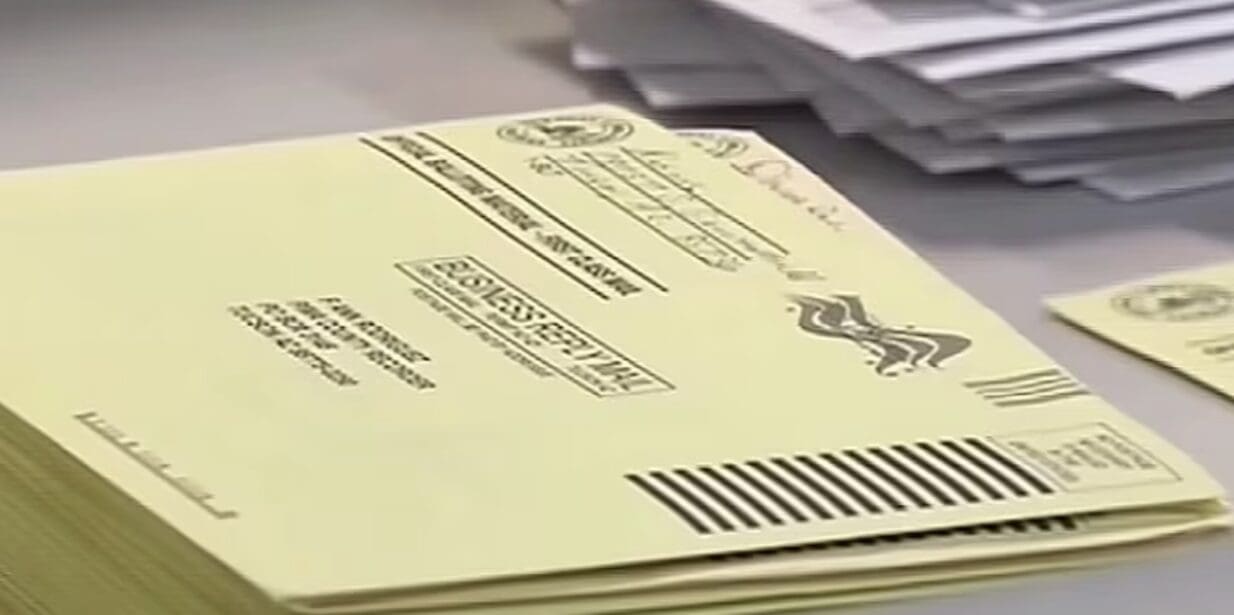
The Founder of Election Watch Peter Bernegger explains President Trump’s new election-mail Executive Order USPS:
Most people have no idea what President Trump’s new election-mail Executive Order USPS rule actually does.
1. Plain English: it creates a chain-of-custody system for mail ballot envelopes in federal elections.
ADVERTISEMENT
2. Not the vote, the envelope.
3. Under the proposed USPS rule, states using mail-in or absentee ballots for federal elections would have to use standardized ballot envelopes:
-Official Election Mail logo
-Automation-compatible design
-Unique Intelligent Mail barcode
-USPS review of envelope/barcode placement
4. That means the ballot envelope becomes trackable.
5. States or election mailers would also submit key data through a USPS portal:
ADVERTISEMENT
-Voter name
-Voter address
-Outbound envelope barcode
-Return envelope barcode
-Originating election office state
6. So officials can know: this ballot envelope was sent out, and this return envelope came back.
7. USPS would review outbound ballot mail before accepting it.
-Is it in the right envelope?
-Does it have the proper barcode?
-Is it going to someone enrolled on that state’s mail-
ballot participation list?
8. If not, the mailing goes back to the election mailer to fix.
9. The broader Executive Order also directs DHS + SSA to help create State Citizenship Lists using federal citizenship, naturalization, SSA, SAVE, and related data.
10. Those lists go to state election officials before federal elections.
ADVERTISEMENT
11. Important: states still run voter registration. The federal list does not register anyone by itself.
12. Bottom line: this is not “tracking your vote.”
13. It tracks the envelope, creates a sent-vs-returned audit trail, helps flag discrepancies, preserves ballot-envelope records, and leaves states responsible for their voter rolls.
14. Chain of custody is not suppression. It is basic election accountability.
15. I used “proposed rule” because USPS has not finalized the rule yet.
16. The proposal says it applies to general, special, and runoff federal elections, not primaries or UOCAVA military/overseas ballots, and it requires unique barcodes on outbound and return envelopes.
17. The rule would require voter name/address plus outbound and return envelope barcode data through a USPS portal, with updates allowed until the last day ballots may be mailed under state law.
18. It also says USPS does not alter voter eligibility or manage state voter rolls.
19. The EO separately directs DHS/SSA to create State Citizenship Lists and directs DOJ enforcement and five-year preservation of participation records, excluding cast ballots.
20. There is one more thing it does, all I’ll say is, watch out ballot mills.
ENSURING CITIZENSHIP VERIFICATION AND INTEGRITY IN FEDERAL ELECTIONS
By the authority vested in me as President by the Constitution and the laws of the United States of America, including the Help America Vote Act of 2002 (52 U.S.C. 20901 et seq.), the National Voter Registration Act of 1993 (52 U.S.C. 20501 et seq.), and the Federal Government’s constitutional obligation to guarantee a republican form of Government to every State in the Union, U.S. Const. Art. IV, Sec. 4, it is hereby ordered:
Section 1. Purpose and Policy. The right to vote in Federal elections is reserved exclusively for citizens of the United States under the Constitution and Federal law. Federal statutes explicitly prohibit non-citizens from registering to vote or voting in Federal elections and impose criminal penalties for violations. (18 U.S.C. 241; 18 U.S.C. 611; 18 U.S.C. 1015; and 52 U.S.C. 20511). The Social Security Administration (SSA) maintains records that, in conjunction with the Department of Homeland Security’s (DHS) Systematic Alien Verification for Entitlements (SAVE) program under 42 U.S.C. 1320b-7, can assist in verifying identity and Federal election voter eligibility.
The Federal Government has an unavoidable duty under Article II of the Constitution of the United States to enforce Federal law, which includes preventing violations of Federal criminal law and maintaining public confidence in election outcomes. To enhance election integrity via the United States Mail, additional measures are necessary. Secure ballot envelope identifiers provide a reliable, auditable mechanism to enforce Federal law without unduly burdening or infringing on the rights of eligible voters. Unique ballot envelope identifiers, such as bar codes, enable confirmation that only citizens receive and cast ballots, reducing the risk of fraud and protecting the integrity of Federal elections.
Sec. 2. Establishment and Transmission of State Citizenship Lists and Prioritization of Investigations and Prosecutions Related to Election Fraud. (a) To the extent feasible and consistent with applicable law, including but not limited to the Privacy Act of 1974 (5 U.S.C. 552a), the Secretary of Homeland Security, through the Director of United States Citizenship and Immigration Services and in coordination with the Commissioner of SSA, shall take appropriate action to compile and transmit to the chief election official of each State a list of individuals confirmed to be United States citizens who will be above the age of 18 at the time of an upcoming Federal election and who maintain a residence in the subject State (State Citizenship List). The State Citizenship List shall be derived from Federal citizenship and naturalization records, SSA records, SAVE data, and other relevant Federal databases. The State Citizenship List shall be updated and transmitted to State election officials no fewer than 60 days before each regularly scheduled Federal election, or promptly upon request by a State in connection with any special Federal election. The Secretary of Homeland Security shall establish procedures to (i) allow individuals to access their individual records as well as to update or correct them in advance of elections; and (ii) enable States to routinely supplement and provide suggested modifications or amendments to the State Citizenship List transmitted thereto. An individual’s identification on the State Citizenship List does not indicate that the individual has been properly registered to vote in the State. State and Federal laws and State procedures must still be followed for an individual to be registered to vote. There may be State laws, not reflected in the State Citizenship List, that preclude voter registration, or the individual may choose not to be registered.
(b) For purposes of this order, an individual is “eligible to vote in a Federal election” if the individual is a citizen of the United States, 18 years of age or older by the date of the upcoming election, and otherwise qualified under the laws of his or her State. The Attorney General shall prioritize the investigation and, as appropriate, the prosecution of State and local officials or any others involved in the administration of Federal elections who issue Federal ballots to individuals not eligible to vote in a Federal election, including under 18 U.S.C. 2(a), 18 U.S.C. 241, 18 U.S.C. 371, 18 U.S.C. 611(a), 18 U.S.C. 1001, 18 U.S.C. 1015, 52 U.S.C. 10307, and 52 U.S.C. 20511. Similarly, the Attorney General shall prioritize the investigation and, as appropriate, the prosecution of individuals and public or private entities engaged in, or aiding and abetting, the printing, production, shipment, or distribution of ballots to individuals who are not eligible to vote in a Federal election.
Sec. 3. United States Postal Service Rulemaking on Mail-In and Absentee Ballots. (a) The unlawful use of the mail in connection with elections is prohibited by various Federal statutes, including 18 U.S.C. 1341, 18 U.S.C. 1708, 52 U.S.C. 10307, and 52 U.S.C. 20511.
(b) To ensure the faithful execution of Federal law, protect the integrity of the mail as a medium for transmitting Federal election ballots and establish uniform standards for mail-in or absentee ballot services implemented through the United States Postal Service (USPS), the Postmaster General is hereby directed to initiate a proposed rulemaking pursuant to 39 U.S.C. 401 and other applicable authority within 60 days of the date of this order. The notice of proposed rulemaking shall include, at minimum, the following:
(i) Proposed provisions specifying that all outbound ballot mail must be mailed in an envelope that:
(A) is marked as Official Election Mail, including through designated markings provided by USPS for this purpose, such as the Official Election Mail logo, as necessary and appropriate;
(B) is automation-compatible and bears a unique Intelligent Mail barcode, or successor USPS technology, that facilitates tracking and is consistent with the other requirements of this section; and
(C) has undergone a mail envelope design review by the USPS to ensure compliance with USPS mailing standards, including barcode placement.
(ii) Proposed provisions specifying that, no fewer than 90 days prior to a Federal election, any State may choose to notify the USPS if it intends to allow for mail-in or absentee ballots to be transmitted by the USPS. As part of that notification, any notifying State should further indicate whether it intends to submit to the USPS, no fewer than 60 days before the election, a list of voters eligible to vote in a Federal election in such State to whom the State intends to provide a mail-in or absentee ballot to be transmitted via the USPS.
(iii) Proposed provisions specifying that the USPS shall not transmit mail-in or absentee ballots from any individual unless those individuals have been enrolled on a State-specific list described in subsection (b)(iv) of this section with the USPS pursuant to this subsection.
(iv) Proposed provisions specifying that the USPS shall provide each State with a list of individuals (Mail-In and Absentee Participation List) who are enrolled with the USPS, pursuant to a process specified in the rulemaking directed by this subsection, for mail-in or absentee ballots provided by such State, along with unique ballot envelope identifiers, such as bar codes, for mail-in or absentee ballots provided to such individuals. The preparation and transmission of each State-specific Mail-In and Absentee Participation List shall comply with the Privacy Act and all applicable use agreements.
(v) Proposed procedures enabling each State to routinely supplement and provide suggested modifications or amendments to the State’s Mail-In and Absentee Participation List in advance of any Federal election, consistent with applicable State law.
(c) The USPS shall coordinate with the USPS Office of Inspector General and the Department of Justice for investigation of suspected unlawful use of the mail involving Federal election materials.
(d) Any final rule pursuant to this section shall be issued no later than 120 days from the date of this order.
Sec. 4. Implementation. (a) The Secretary of Homeland Security, the Commissioner of SSA, and the Postmaster General shall coordinate with the Secretary of Commerce in effectuating all relevant aspects of the implementation of this order.
(b) The Attorney General shall enforce compliance with the applicable Federal statutes referenced herein and provide guidance to election officials, including any instrumentalities thereof; contractors; individuals involved in the administration of Federal elections; or public or private entities engaged in the printing, production, shipment, or distribution of ballots.
(c) The Secretary of Homeland Security shall, within 90 days of the date of this order, establish the infrastructure necessary to compile, maintain, and transmit the State Citizenship List described in section 2(a) of this order, and shall designate a point of contact within DHS to receive and process requests from individuals and State election officials regarding the relevant State Citizenship List. The Commissioner of SSA shall provide all necessary citizenship and identity data to the Secretary of Homeland Security in support of this requirement, consistent with applicable law, the Privacy Act, and all applicable use agreements.
Sec. 5. Enforcement. The Attorney General and the heads of executive departments and agencies (agencies) with relevant authority shall take all lawful steps to deter and address noncompliance with Federal law, including withholding Federal funds from noncompliant States and localities where such withholding is authorized by law. Evidence of violations of existing Federal laws by State or local election officials; States or localities, including any instrumentalities thereof; contractors; individuals involved in the administration of Federal elections; or public or private entities engaged in the printing, production, shipment, or distribution of ballots may be referred to the Department of Justice for consideration of investigation or charges under 18 U.S.C. 2(a), 18 U.S.C. 241, 18 U.S.C. 371, 18 U.S.C. 611(a), 18 U.S.C. 1001, 18 U.S.C. 1015, 52 U.S.C. 10307, and 52 U.S.C. 20511. States and localities should preserve, for a 5-year period, all records and materials — excluding ballots cast — evidencing voter participation in any Federal election (e.g., ballot envelopes, regardless of carrier).
Sec. 6. Severability. If any provision of this order, or the application of any provision to any agency, person, or circumstance, is held to be invalid, the remainder of this order and the application of its provisions to any other agencies, persons, or circumstances shall not be affected thereby.
Sec. 7. General Provisions. (a) Nothing in this order shall be construed to impair or otherwise affect:
(i) the authority granted by law to an executive department or agency, or the head thereof; or
(ii) the functions of the Director of the Office of Management and Budget relating to budgetary, administrative, or legislative proposals.
(b) This order shall be implemented consistent with applicable law and subject to the availability of appropriations.
(c) This order is not intended to, and does not, create any right or benefit, substantive or procedural, enforceable at law or in equity by any party against the United States, its departments, agencies, or entities, its officers, employees, or agents, or any other person.
DONALD J. TRUMP
THE WHITE HOUSE,
March 31, 2026.
Related
The Truth Must be Told
Your contribution supports independent journalism
Please take a moment to consider this. Now, more than ever, people are reading Geller Report for news they won't get anywhere else. But advertising revenues have all but disappeared. Google Adsense is the online advertising monopoly and they have banned us. Social media giants like Facebook and Twitter have blocked and shadow-banned our accounts. But we won't put up a paywall. Because never has the free world needed independent journalism more.
Everyone who reads our reporting knows the Geller Report covers the news the media won't. We cannot do our ground-breaking report without your support. We must continue to report on the global jihad and the left's war on freedom. Our readers’ contributions make that possible.
Geller Report's independent, investigative journalism takes a lot of time, money and hard work to produce. But we do it because we believe our work is critical in the fight for freedom and because it is your fight, too.
Please contribute here.

or
Make a monthly commitment to support The Geller Report – choose the option that suits you best.
ADVERTISEMENT
Quick note: We cannot do this without your support. Fact. Our work is made possible by you and only you. We receive no grants, government handouts, or major funding.Tech giants are shutting us down. You know this. Twitter, LinkedIn, Google Adsense, Pinterest permanently banned us. Facebook, Google search et al have shadow-banned, suspended and deleted us from your news feeds. They are disappearing us. But we are here.
Subscribe to Geller Report newsletter here— it’s free and it’s essential NOW when informed decision making and opinion is essential to America's survival. Share our posts on your social channels and with your email contacts. Fight the great fight.
Follow Pamela Geller on Gettr. I am there. click here.
Follow Pamela Geller on Trump's social media platform, Truth Social. It's open and free.
Remember, YOU make the work possible. If you can, please contribute to Geller Report.
Join The Conversation. Leave a Comment.
We have no tolerance for comments containing violence, racism, profanity, vulgarity, doxing, or discourteous behavior. If a comment is spammy or unhelpful, click the ... symbol to the right of the comment to let us know. Thank you for partnering with us to maintain fruitful conversation.






recent Comments